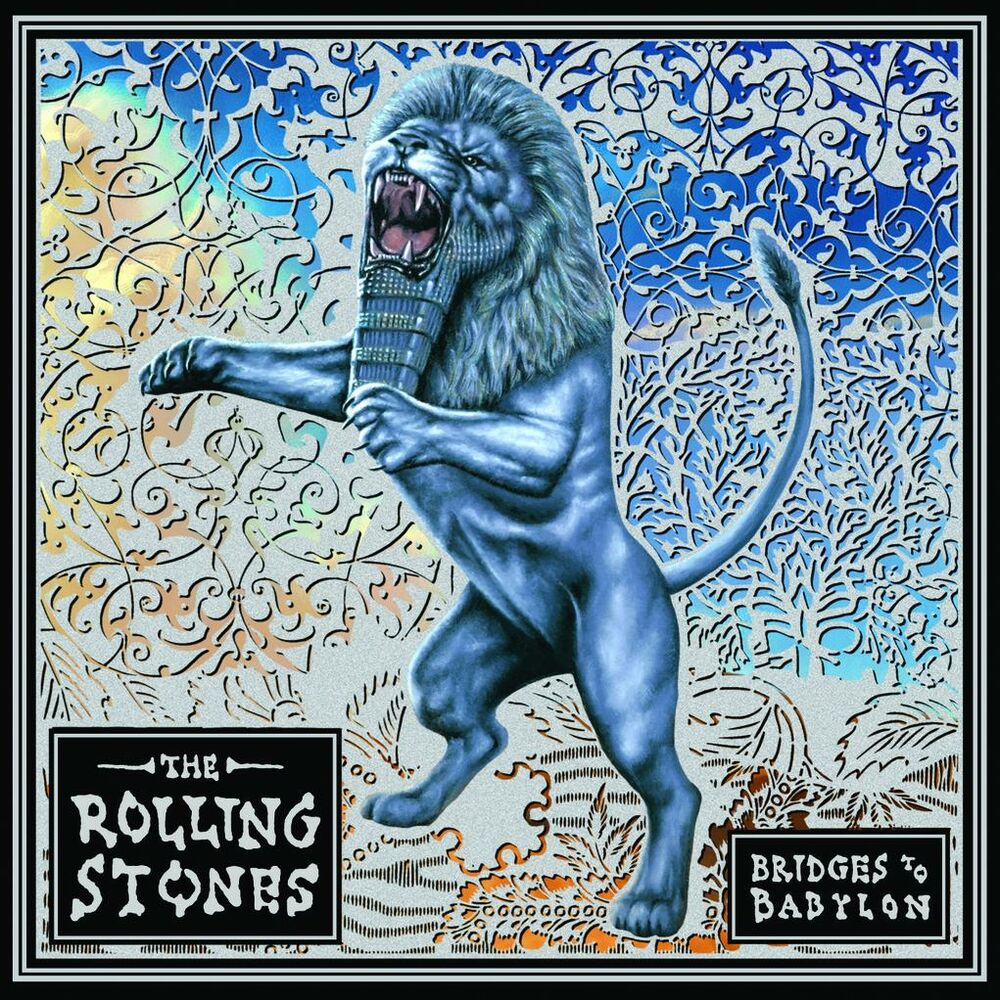
Bridges To Babylon (Remastered)
- Released1 September 2008
- UK peak No. 6
- Weeks on UK chart 10
- Entered UK chart 5 October 1997
- LabelPolydor Records
- Tracks13 · 62 min
3 tracks from it charted as singles. Press a flag to play it in the chart where it peaked.
Tracks
| 1 | Flip The Switch (Remastered) | 3:28 | |
| 2 | Anybody Seen My Baby? (Remastered 2009) No. 22 · 1997 | 4:31 | |
| 3 | Low Down (Remastered) | 4:26 | |
| 4 | Already Over Me (Remastered) | 5:24 | |
| 5 | Gunface (Remastered) | 5:02 | |
| 6 | You Don't Have To Mean It (Remastered) | 3:44 | |
| 7 | Out Of Control No. 51 · 1998 | 4:43 | |
| 8 | 5:15 | ||
| 9 | Might As Well Get Juiced (Remastered) | 5:23 | |
| 10 | Always Suffering (Remastered) | 4:43 | |
| 11 | Too Tight (Remastered) | 3:33 | |
| 12 | Thief In The Night (Remastered) | 5:15 | |
| 13 | How Can I Stop (Remastered) | 6:53 |
About the album
Bridges to Babylon is the twenty-first British and twenty-third American studio album by the English rock band the Rolling Stones. It was released on 29 September 1997, through Virgin Records. The album contains contributions from a host of producers—Don Was, returning from Voodoo Lounge (1994), as well as the Dust Brothers, Danny Saber, Rob Fraboni and Pierre de Beauport—with all of the tracks also being produced by Mick Jagger and Keith Richards (as "the Glimmer Twins"). The album contains a multitude of musical styles, such as rock and roll, blues, reggae, and electronic music, as a result of Jagger's desire to mix the band's traditional sound with the contemporary styles of the day.
Upon release, Bridges to Babylon sold well and received mostly positive reviews. Its lead single, "Anybody Seen My Baby?", was a worldwide top 40 hit and was successful on US rock and alternative radio. The album reached the top 3 in the US and topped the charts throughout Europe, though it became the band's first (and, to date, only) album to peak outside the top 5 in the UK. Reviewers were divided on the merits of the band's experiments with then-current trends and styles, though certain tracks were consistently singled out for praise. The following Bridges to Babylon Tour ran through 1997 and 1998 and was extremely successful, becoming the second-highest-grossing tour at the time.
Background and recording
Following the Voodoo Lounge Tour from 1994 to 1995, and the album Stripped, the Stones afforded themselves a brief respite before Mick Jagger and Keith Richards began composing new songs together in the summer of 1996, with demos to follow as they met in New York in November and London the following month. Another writing session took place in Barbados in January 1997.
In March 1997, the band arrived in Los Angeles to start the recording sessions at Ocean Way Studios. After many albums recorded in isolated islands, working in a big city allowed for the contribution of various musician friends of the band. Bridges to Babylon was recorded until July, and the four-month production made it one of their most concise periods of recording in years. The sessions were frequently all-nighters that lasted until Richards got tired by the morning.
Although Don Was produced again, Jagger arrived before the other members of the Stones to seek local producers. First were The Dust Brothers, who had impressed Jagger with their work on Beck's Odelay and the Beastie Boys' Paul's Boutique.
Packaging
Once the Rolling Stones had picked Stefan Sagmeister to be the album's art director, Jagger told him to seek inspiration from Babylonian art exhibited at the British Museum. Sagmeister was most impressed by a Lamassu sculpture featuring a lion with a human head and beard and commissioned artist Kevin Murphy to paint a similar Assyrian lion in an attack stance. The first million units of Bridges to Babylon were encased in a specially manufactured filigree slipcase that gave the impression that the lion was embedded into the design. The desert background of the cover was extended throughout the booklet, featuring ruins that were the basis for the stage design of the Bridges to Babylon Tour.
Release and reception
Bridges to Babylon reached No. 6 in the UK, No. 2 in France and No. 3 in the US, where it was certified platinum by the RIAA in November 1997. As of January 2010, it had sold 1.1 million copies in the US. Further singles "Saint of Me" and concert staple "Out of Control" were also minor hits. By this point, the Stones had become a touring phenomenon. The Bridges to Babylon Tour in 1997 consisted of 108 concerts, with an elaborate stage design Jagger aimed to make similar to U2's PopMart Tour. In 2009, Bridges to Babylon was remastered and reissued by Universal Music.
Critical reception
Bridges to Babylon was released to mixed-to-positive reviews. Rolling Stone writer Mark Kemp found that the majority of the album "come[s] off feral without sounding forced [and] contemporary without succumbing to modern-rock trendiness". Kemp praised the band's collaboration with contemporary producers and the integration of new sounds and styles, while also highlighting the three Richards vocals as "some of the stronger songs" on the record. Paul Moody of the NME praised the "bizarre brilliance" of "Saint of Me", "Thief in the Night", and "Might as Well Get Juiced", citing the record as evidence that the band had "pretty much seen off the curse of age-old pop group reality". Rockpile's Lorraine Gennaro stated the record "has everything Stones fans have come to know and love", highlighting Richards' playing as "still sound[ing] oh-so-sweet". Hits declared that "The Glimmer Twins are back with piss, vinegar and a really megalithic cash-cow tour", finding that "beneath the beasty/flowery cover art of Bridges... rocks an album with magnitude to match".