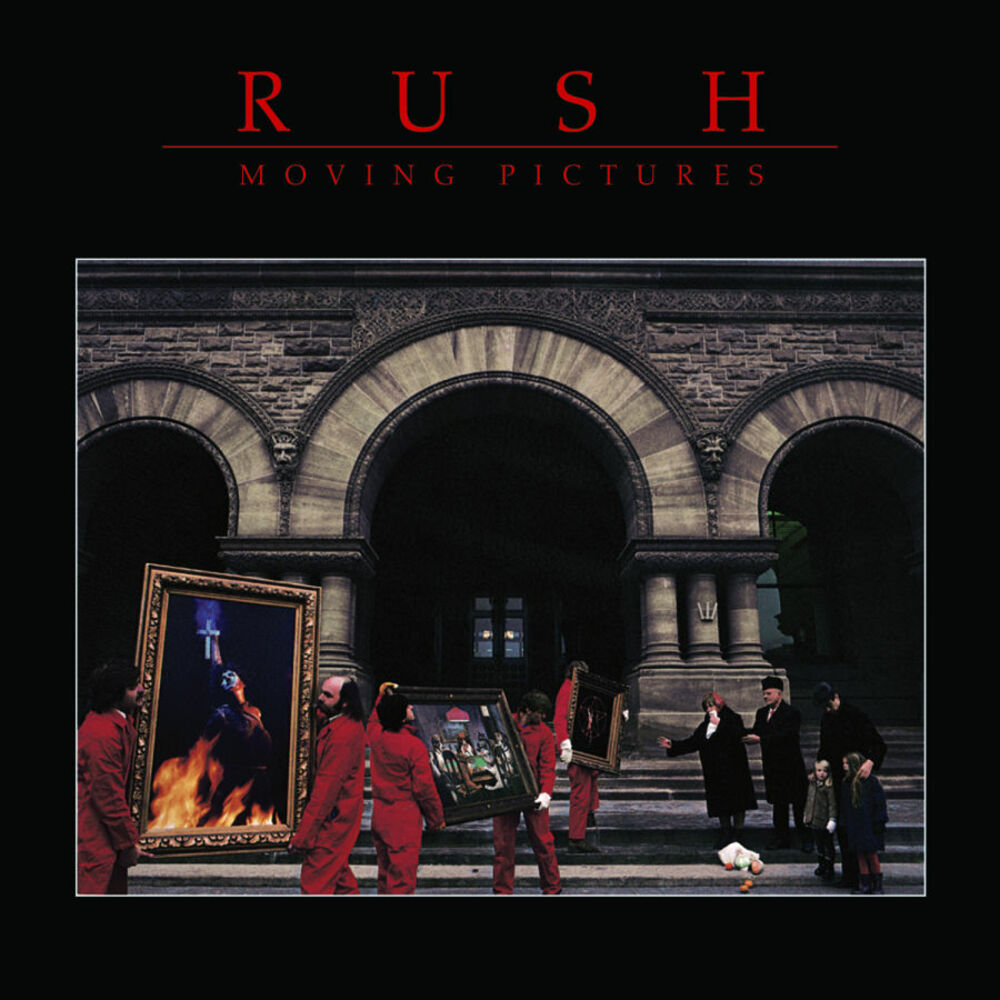
Moving Pictures (2011 Remaster)
- Released19 April 2011
- UK peak No. 3
- Weeks on UK chart 13
- Entered UK chart 15 February 1981
- LabelMercury Records
- Tracks7 · 40 min
3 tracks from it charted as singles. Press a flag to play it in the chart where it peaked.
Tracks
| 1 | 4:36 | ||
| 2 | Red Barchetta | 6:10 | |
| 3 | YYZ | 4:25 | |
| 4 | Limelight No. 55 · 1981 | 4:19 | |
| 5 | The Camera Eye | 11:01 | |
| 6 | Witch Hunt | 4:45 | |
| 7 | Vital Signs No. 41 · 1981 | 4:46 |
About the album
Moving Pictures is the eighth studio album by Canadian rock band Rush, released on February 12, 1981, by Anthem Records. After touring to support their previous album, Permanent Waves (1980), the band started to write and record new material in August 1980 with longtime co-producer Terry Brown. They continued to write songs with a more radio-friendly sound, featuring tighter and shorter song structures compared to their earlier albums.
"Limelight", "Tom Sawyer" and "Vital Signs" were released as singles across 1981, and the instrumental "YYZ" was nominated for a Grammy Award for Best Rock Instrumental Performance. Rush supported the album on tour from February to July 1981. In 2020, Rolling Stone ranked the album number 379 on its list of the "500 Greatest Albums of All Time".
Moving Pictures received a positive reception from contemporary and retrospective music critics and became an instant commercial success. The album reached number one in Canada and number three in both the United States and the United Kingdom. Moving Pictures is the fastest-selling album in the band's catalogue. It was certified Platinum by the RIAA on April 27, 1981 for one million copies sold, just two months after the album's release. It has since been certified Platinum five times over, for five million copies sold in the United States.
Background and recording
In June 1980, the band ended their 10-month tour of the United States, Canada and the United Kingdom in support of their previous album, Permanent Waves (1980). The tour was a commercial success for the group, becoming the first of their career to earn them a profit. During their stop in New York City a month prior, the band decided to scrap plans for a second live album in favor of making a new one in the studio. Cliff Burnstein of Mercury Records suggested the idea to the band, and Neil Peart was particularly enthusiastic about the new ideas that were being developed at sound checks and was keen to put them to tape. Geddy Lee and Alex Lifeson caught on to his enthusiasm. The trio pitched the idea to their manager and producer, who had already mapped out a two-year plan for them, but agreed to the change and cancelled the schedule. Lifeson looked back on this change of plan as the most important one in the band's history since the decision to record 2112 (1976), which became their breakthrough hit.
Artwork
The cover was designed by Hugh Syme who estimated the artwork cost $9,500 to produce. Anthem Records refused to cover the entire bill, leaving the band to pay for the rest. It is a triple entendre; the front depicts movers who are carrying pictures. On the side, people are shown crying because the pictures passing by are emotionally "moving". Finally, the back cover has a film crew making a motion (moving) picture of the whole scene. It was photographed outside the Ontario Legislative Building at Queen's Park, Toronto. The pictures that are being moved are the band's Starman logo featured on the reverse cover of 2112 (1976), one of the Dogs Playing Poker paintings entitled A Friend in Need, and a painting that shows Joan of Arc being burned at the stake. The film crew on the back cover actually shot the scene, from which a single frame was used for the cover.
Release
Moving Pictures was played in its entirety during Lee's visit to Rick Ringer's radio show on CHUM-FM in Toronto, on February 11, 1981. The album was released on the following day.
Reception and legacy
Kerrang! magazine listed the album at No. 43 among the "100 Greatest Heavy Metal Albums of All Time". Rolling Stone has listed Moving Pictures at No. 10 on the 2012 readers poll 'Your Favorite Prog Rock Albums of All Time', at No. 3 on the 2015 list '50 Greatest Prog Rock Albums of All Time' (behind Pink Floyd's The Dark Side of the Moon at number one and King Crimson's In the Court of the Crimson King at number two), and at No. 379 on the 2020 edition of its 500 Greatest Albums of All Time. In 2014, readers of the Rhythm voted Moving Pictures the greatest drumming album in the history of progressive rock. Moving Pictures and 2112 (1976) are the two Rush albums listed in 1001 Albums You Must Hear Before You Die.
Reissues
The album was released on compact disc in 1984 by Mercury Records. Initial pressings were missing the first beat of "Tom Sawyer" by mistake but were corrected in subsequent releases. In 1997, Mercury Records released a digitally remastered version. The disc tray has a logo of three fingerprints with "The Rush Remasters" printed, a feature of all remastered albums from Moving Pictures through A Show of Hands, originally found on the cover of Retrospective II. The remaster restores all of the original artwork and lyrics found on the vinyl release (including the picture of Peart that had been left off of the original CD issue).
Moving Pictures was remastered twice in 2011. The first, by Andy VanDette, was for the "Sector" box sets which re-released all of Rush's Mercury-era albums. It is included in the Sector 2 box set. The second reissue was in April 2011, as a two-disc 30th-anniversary set.