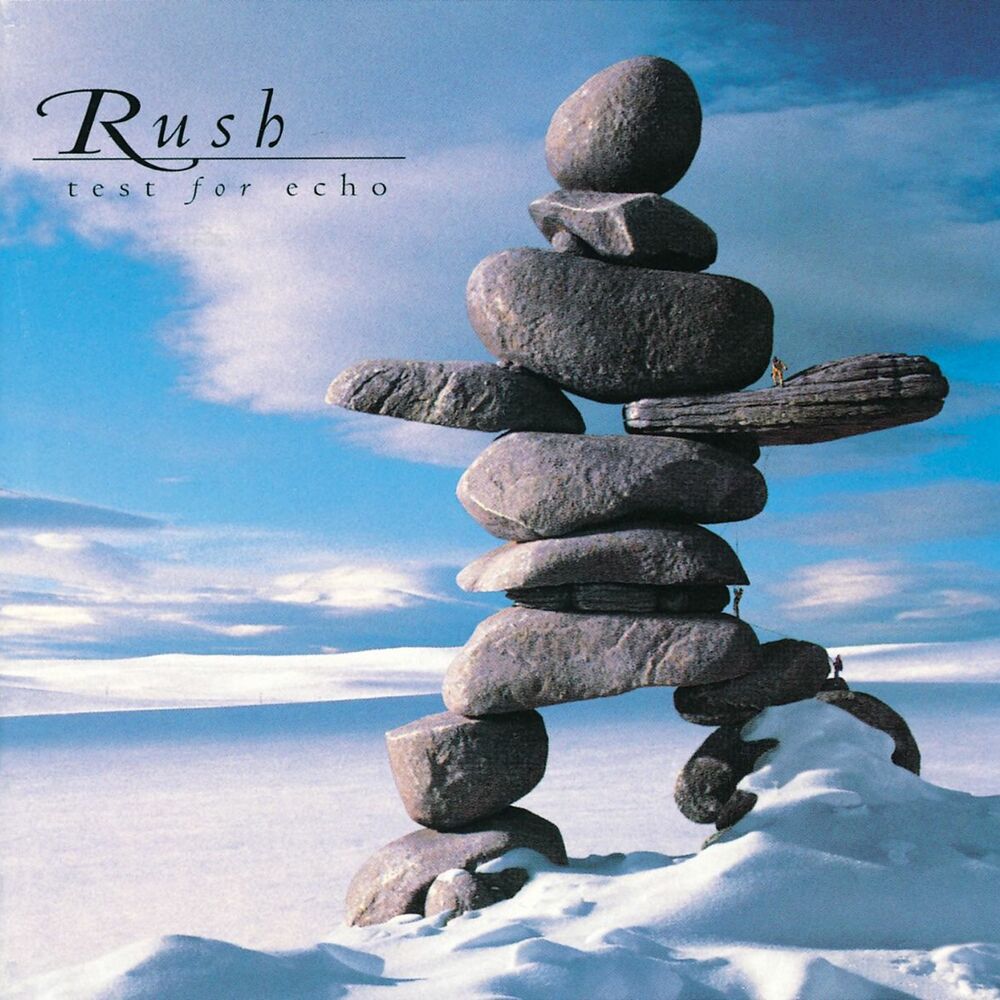
Test for Echo (2004 Remaster)
- Released6 September 1996
- UK peak No. 25
- Weeks on UK chart 3
- Entered UK chart 15 September 1996
- LabelAtlantic Records
- Tracks11 · 53 min
Tracks
| 1 | Test for Echo (2004 Remaster) | 5:55 | |
| 2 | Driven (2004 Remaster) | 4:26 | |
| 3 | Half the World (2004 Remaster) | 3:42 | |
| 4 | The Color of Right (2004 Remaster) | 4:48 | |
| 5 | Time and Motion (2004 Remaster) | 5:01 | |
| 6 | Totem (2004 Remaster) | 4:58 | |
| 7 | Dog Years (2004 Remaster) | 4:55 | |
| 8 | Virtuality (2004 Remaster) | 5:43 | |
| 9 | Resist (2004 Remaster) | 4:23 | |
| 10 | Limbo (2004 Remaster) | 5:29 | |
| 11 | Carve Away the Stone (2004 Remaster) | 4:07 |
About the album
Test for Echo is the sixteenth studio album by the Canadian rock band Rush, released on September 10, 1996, by Anthem Records. It was the final Rush album to be co-produced by Peter Collins. The band supported the album with a world tour in 1996 and 1997, after which they went on a five-year hiatus following the deaths of drummer Neil Peart's daughter and wife.
The title track reached No. 1 on the mainstream rock chart. The song "Driven" became a bass showcase for Geddy Lee during live performances, while "Resist" was rearranged as an acoustic song on the Vapor Trails and R30 tours. The band did not perform any tracks from the album on subsequent tours. Test for Echo was remastered and reissued twice: in 2004 as a continuation of "The Rush Remasters" set and in 2013 as a part of the box set The Studio Albums 1989–2007. In 2015, it was reissued after being remastered at Abbey Road Studios by Sean Magee, whom Rush had hired to remaster their back catalogue.
Background and pre-production
In May 1994, Rush finished their Counterparts Tour of the United States and Canada in support of the band's 15th album Counterparts (1993). The group's customary post-tour break became an 18-month hiatus because bass guitarist and vocalist Geddy Lee wanted to be at home for the first year of his daughter's life. With their free time, guitarist Alex Lifeson recorded his first solo album Victor and drummer/lyricist Neil Peart released a Buddy Rich tribute album Burning for Buddy and spent time on his technique, receiving formal instruction from the jazz drummer Freddie Gruber. For the majority of the album, Peart plays with a traditional grip.
In October 1995, the band decided to start work on the next Rush album and, as with their previous three albums, retreated to Chalet Studios in Claremont, Ontario, to write and rehearse. Having been together for more than 20 years at this point, Lifeson questioned whether Test for Echo would be Rush's last album, and if they would tour behind it.
Recording
The album was recorded from January to March 1996 at Bearsville Studios in Bearsville, New York. The studio was chosen because the band wanted to capture "more size" from Peart's drums and the facility was more suited to his kit. Additional recording took place at Reaction Studios in Toronto, where it snowed for 40 consecutive days. Test for Echo was the first time Rush worked with American engineers and mixers, having only worked with English or Australian personnel before. They chose the recording engineer Clif Norrell, a longtime fan of the band who once performed Rush cover songs in his own group.
The album was mixed in April 1996 by Andy Wallace at McClear Place in Toronto. The group made a conscious decision not to enter the studio until Wallace had prepared a mix for them to comment on. Lifeson said, "We'd hear completely different takes on these songs that we'd lived with for six or seven months. [...] There were things that we really wouldn't have thought of, and that was really the whole point of him being there".
Artwork
The cover displays an inuksuk, native to Canada. Created by the Inuit, an inuksuk is a stone figure in the shape of a human used to mark a food cache, hunting ground or a place where someone lost their life.
Release
The album was premiered in its entirety during a two-hour syndicated radio special on WRCX in Chicago, on September 5, 1996.
Reception
The AllMusic reviewer, Stephen Thomas Erlewine, gave Test for Echo three out of five stars, saying that Rush has "rarely played better in the past ten years than they have on Test for Echo". Rolling Stone argued, "the buffed guitar and synthesizer contours of Test for Echo are welcome relief from the bland din of modern-rock celebrities like Dishwalla."
In a retrospective analysis, Geddy Lee stated in Rush: An Oral History, Uncensored that Test for Echo was a "strange record" saying "Test for Echo was a strange record in a sense. It doesn’t really have a defined direction. I kind of felt like we were a bit burnt creatively. It was a creative low time for us."