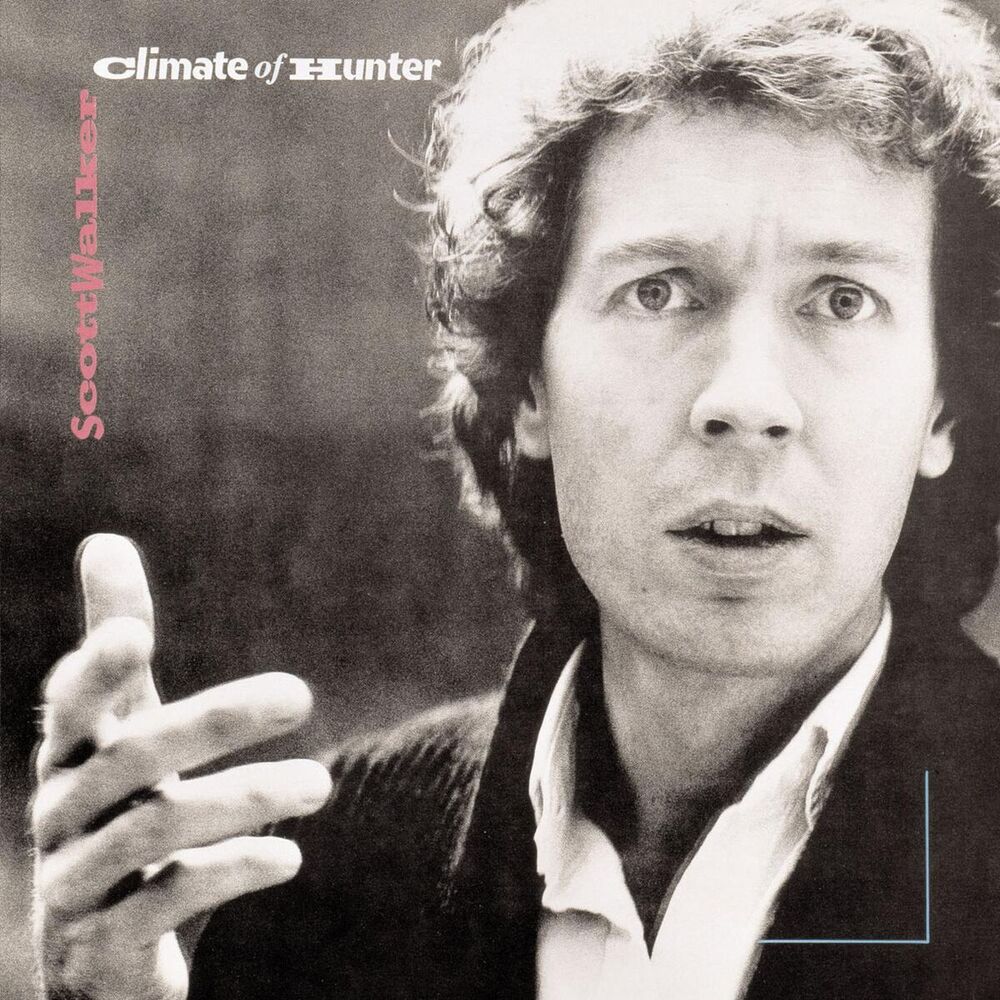
Climate Of Hunter
- Released24 September 2007
- UK peak No. 60
- Weeks on UK chart 2
- Entered UK chart 25 March 1984
- LabelVirgin Catalogue
- Tracks8 · 31 min
Tracks
| 1 | Rawhide (Remastered 2006) | 3:56 | |
| 2 | Dealer (Remastered 2006) | 5:12 | |
| 3 | Track Three (Remastered 2006) | 3:50 | |
| 4 | Sleepwalkers Woman (Remastered 2006) | 4:11 | |
| 5 | Track Five (Remastered 2006) | 3:36 | |
| 6 | Track Six (Remastered 2006) | 3:36 | |
| 7 | Track Seven (Remastered 2006) | 3:47 | |
| 8 | Blanket Roll Blues (Remastered 2006) | 3:16 |
About the album
Climate of Hunter is the eleventh solo studio album by the American singer-songwriter Scott Walker. It was released in March 1984 and reached number 60 on the UK Albums Chart. It was his only album of the 1980s.
The album was a comeback of sorts for Walker, following a decade and a half of commercial decline and artistic frustration, and coming off the heels of a renewed interest in his 1960s work from the UK post-punk and indie scene. Walker wrote the songs for the album between August and September 1983, and it was recorded between October and December 1983 in the UK at The Town House, EMI and Sarm West Studios. The album was released as an LP in March 1984, receiving positive reviews. It was released on CD in the late 1980s, and reissued on CD in January 2006, with revised artwork and having been remastered. The original artwork for the album was designed by C.More.Tone, with photography by Bob Carlos Clarke.
Background
Following the commercial failures of 1969's Scott 4 and 1970's 'Til the Band Comes In, Scott Walker spent the next few years releasing MOR albums consisting entirely of cover versions. After the last album of this period, 1974's We Had It All, Walker reformed The Walker Brothers and signed to GTO Records. The first two albums from the reunited group, 1975's No Regrets and 1976's Lines, followed the style of Walker's recent solo work, with neither album including any original songs by him. The title track of the first album, "No Regrets", became a hit single, but critically and commercially both albums were unsuccessful.
The group began recording the third and final album of their reunion period, 1978's Nite Flights, knowing that GTO was soon to collapse. The decision was made to produce an album of their own compositions without compromise. In contrast to the MOR/soft rock style of the previous two albums, Nite Flights featured elements of art rock, hard rock and new wave, utilising harder drums, synthesizers and electric guitars.
Recording and music
Although it took Walker a long time to write the songs, the recording of the album was relatively quick, taking two months from October to December 1983. The album was produced with Peter Walsh who had recently worked with Simple Minds on their break-through album, 1982's New Gold Dream (81–82–83–84). Together with Walsh, Walker assembled a band of seasoned session players such as free-improvising saxophone player Evan Parker, Dire Straits' Mark Knopfler on guitar and the R&B singer Billy Ocean.
Discussing the recording of the album for the documentary Scott Walker: 30 Century Man (2006), Walsh explained that the musicians were expected to record their parts without knowing the melody to any of the songs, in part because Walker had not recorded any demos and also because the melody was "a closely guarded secret". Walker explained that if the others involved knew the melody, it would take the song away from the "concentrated place" he intended.
Reception
Climate of Hunter received mixed to positive reviews by the majority of critics. It was ranked number 5 among the "Albums of the Year" for 1984 by NME. Its reputation has risen steadily in the decades since. The Guardian wrote in 2006, "Climate of Hunter remains an enigmatic and frequently magical record; something both to puzzle and marvel at." A 2002 review in Unsung agreed: "I believe the time is right for a reassessment of an album that, unlike so many released in the 1980's, has dated very little and, weird as it is, actually seems to make sounder sense now than it ever did." The A.V. Club said in 2012, "On first listen, the album sounds like it fits with the more danceable side of post-punk and new wave, alongside the likes of Ultravox and OMD. But... the record as a whole has a spaciness and distance about it, as though Walker wrote these songs in 1978, tore them up, then tried to recollect them six years later."