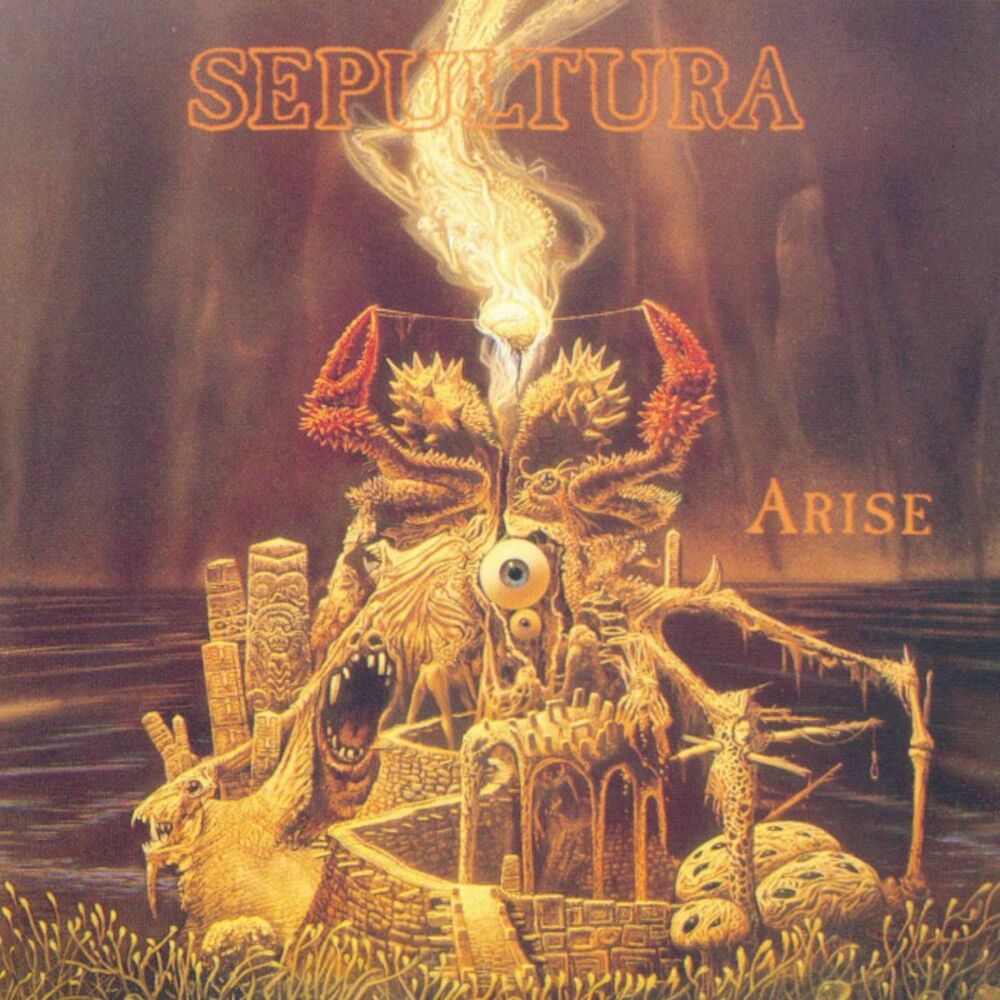
Arise
- Released10 November 1997
- UK peak No. 40
- Weeks on UK chart 2
- Entered UK chart 31 March 1991
- LabelRoadrunner Records
- Tracks13 · 59 min
One track from it charted as a single. Press a flag to play it in the chart where it peaked.
Tracks
| 1 | Arise | 3:18 | |
| 2 | Dead Embryonic Cells | 4:52 | |
| 3 | Desperate Cry | 6:41 | |
| 4 | Murder | 3:26 | |
| 5 | Subtraction | 4:47 | |
| 6 | Altered State | 6:34 | |
| 7 | Under Siege (Regnum Irae) No. 91 · 1991 | 4:54 | |
| 8 | Meaningless Movements | 4:40 | |
| 9 | Infected Voice | 3:18 | |
| 10 | Orgasmatron | 4:14 | |
| 11 | Intro (Arise Sessions) | 1:33 | |
| 12 | C.I.U. (Criminals in Uniform) | 4:16 | |
| 13 | Desperate Cry (Scott Burns Mix) | 6:43 |
About the album
Arise is the fourth studio album by Brazilian heavy metal band Sepultura, released on March 25, 1991, by Roadrunner Records. Released after their breakthrough album, Beneath the Remains (1989), Arise represents the band's experiments with that album's death/thrash style as well as its progressive and technical abilities, and presents the band's first incursions with industrial music, hardcore punk and Latin percussion. Upon its release, it received widespread acclaim in the heavy metal press, and yielded multiple singles. The tour that supported the album was the group's longest at that time, totaling 220 shows in 39 countries from 1991–1992. During the touring, the album went gold in Indonesia, becoming the band's first music industry certification. By the tour's end, Arise had achieved platinum sales worldwide. According to Whiplash's Hagen Kennedy, Arise is widely considered Sepultura's greatest album, and a landmark not only in thrash metal but extreme metal as a whole. The album was inducted into Decibel magazine's "Hall of Fame", becoming the third Sepultura album to receive such award, the previous two being Roots and Beneath the Remains. This induction made Sepultura the first band to have at least three of their albums featured in the Decibel Hall of Fame. It is considered to be an essential release in the thrash genre by Revolver.
Background
After the release of the third album, Beneath the Remains, Sepultura began to receive heavy attention in the international heavy metal scene and toured outside of the United States for the first time. They received additional attention for performances at the Rock in Rio II festival, and their heavily played video for the track "Inner Self". In the midst of this, the band moved to Phoenix, Arizona and acquired new management. In August 1990, the band travelled to Florida to work on the album. Scott Burns reprised his role as producer and audio engineer, and now with a major advantage: Sepultura were at his home studio, Morrisound, a studio properly equipped to record their music style. Their label Roadrunner granted a $40,000 budget, which helped explain the album's improved production values. That allowed drummer Igor Cavalera and Burns, for example, to spend a whole week just testing the drum kit's tunings and experimenting with microphone practice.
Release
Released on March 25, 1991, and April 8 in the United Kingdom, Arise was the first Sepultura record to enter the Billboard charts, at number 145, before peaking at 119. It was also the first to gain a music certification—Arise went gold in 1992 for selling 25,000 copies in Indonesia. By 1993, the album had sold 1 million units around the globe. In 2001, it won a second certification: silver in the United Kingdom, for selling in excess of 60,000 copies.
The album was accompanied by three singles: The title track, "Dead Embryonic Cells", and "Under Siege (Regnum Irae)". Though the title track was banned in American by MTV due to its apocalyptic religious imagery, "Dead Embryonic Cells" would enjoy airplay on Headbanger's Ball. A remastered version of Arise was released by Roadrunner in 1997, with added notes by music critic Don Kaye and four bonus tracks, previously released on the compilation The Roots Of Sepultura: a cover version of Motörhead's "Orgasmatron", a rough mix of "Desperate Cry" and two previously unreleased songs.
Reception
Arise garnered praise from a wide variety of sources. By the time of its release, major Brazilian newspapers were already aware of the band's existence, and advance copies sent to them were generally met with positive reviews. Artur G. Couto Duarte, writing for O Estado de Minas, described Sepultura's soundscapes as "stories describing barren worlds where disease, hunger, torture and death reign supreme". Folha de S.Paulo's Sérgio Sá Leitão pointed out Sepultura's increasing compositional skills, drawing attention to how the band's occasional use of restraint benefited their songs as a whole.
The international pop press also took notice of Brazil's premiere metal group. Top British weeklies such as the Melody Maker and NME wrote lengthy articles on the band, praising them. A Melody Maker journalist wrote: "Sepultura is [...] a Brazilian metal band which seems to be in the verge of getting big – maybe even bigger than Slayer, their only true rival." Genre-specific magazines also reacted positively to the group.