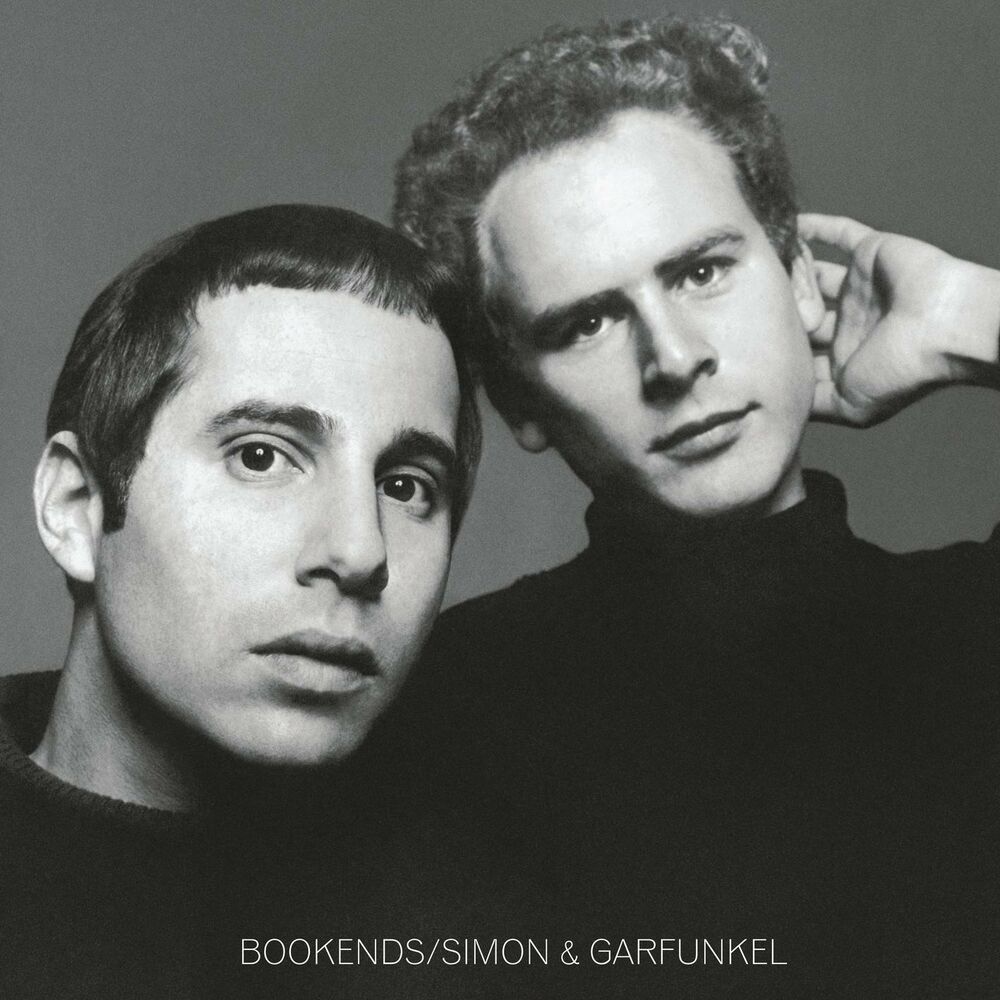
Bookends
- Released24 November 2014
- UK peak No. 1
- Weeks on UK chart 77
- Entered UK chart 28 July 1968
- LabelColumbia
- Tracks12 · 29 min
5 tracks from it charted as singles. Press a flag to play it in the chart where it peaked.
Tracks
| 1 | Bookends Theme | 0:32 | |
| 2 | Save the Life of My Child | 2:49 | |
| 3 | 3:36 | ||
| 4 | Overs | 2:15 | |
| 5 | Voices of Old People | 2:07 | |
| 6 | Old Friends | 2:36 | |
| 7 | Bookends Theme (Reprise) | 1:20 | |
| 8 | Fakin' It No. 23 · 1967 | 3:17 | |
| 9 | Punky's Dilemma | 2:13 | |
| 10 | 4:04 | ||
| 11 | A Hazy Shade of Winter No. 13 · 1966 | 2:17 | |
| 12 | At the Zoo No. 16 · 1967 | 2:23 |
About the album
Bookends is the fourth studio album by the American folk rock duo Simon & Garfunkel. Produced by Paul Simon, Art Garfunkel and Roy Halee, the album was released on April 3, 1968, in the United States by Columbia Records. The duo had risen to fame two years prior with the albums Sounds of Silence and Parsley, Sage, Rosemary and Thyme and the soundtrack album for the 1967 film The Graduate.
Bookends is a concept album that explores a life journey from childhood to old age. Side one of the album marks successive stages in life, the theme serving as bookends to the life cycle. Side two largely consists of previously released singles and of unused material for The Graduate soundtrack. Simon's lyrics concern youth, disillusionment, relationships, old age, and mortality. Much of the material was crafted alongside producer John Simon (no relation), who joined the recording when Paul Simon suffered from writer's block. The album was recorded gradually over the period of a year, with production speeding up around the later months of 1967.
Initial sales for Bookends were substantial in the US, and the album produced the number-one single "Mrs. Robinson". The album sold well in the US and in the United Kingdom, where it peaked at number one.
Background
Simon & Garfunkel first became prominent on American radio in 1965 with their record "The Sound of Silence", which became a hit during a period in which the duo had broken up due to the failure of their debut album, Wednesday Morning, 3 A.M. (1964). Following another release, Sounds of Silence (1966), the duo recorded and released Parsley, Sage, Rosemary and Thyme (1966), which brought new critical and commercial success to the duo. Simon, then 25, felt he had finally "made it" into an upper echelon of rock and roll, while most importantly retaining artistic integrity ("making him spiritually closer to Bob Dylan than to, say, Bobby Darin", wrote biographer Marc Eliot). The duo chose William Morris as their booking agency after a recommendation from Wally Amos, a mutual friend through their producer, Tom Wilson.
During the sessions for Parsley, the duo cut "A Hazy Shade of Winter" and decided to release it as a single then, where it peaked at number 13 on the national charts. Similarly, they recorded "At the Zoo" for single release in early 1967 (it charted lower, at number 16).
Recording and production
Bookends was recorded sporadically from 1966 to 1968. John Simon's first session with the group was for "Fakin' It" in June 1967. The duo were signed under an older contract that specified that the label pay for sessions ("As a folk duo, how much could recording costs be?" said John Simon). Simon & Garfunkel took advantage of this indulgence, hiring viola and brass players, as well as percussionists. When the viola players arrived, the duo were so intrigued with the sound of the musicians tuning their instruments before recording that they spent nearly all night (at Columbia's expense) trying to find the random sound.
The record's brevity reflects its concise and perfectionistic production. The team spent over 50 studio hours recording "Punky's Dilemma", for example, and re-recorded vocal parts, sometimes note by note, until they were satisfied. Simon paid close attention to his vocal takes, and he strived to get each line perfect.
Music
The "Bookends Theme" that opens and closes side one is played on the acoustic guitar, with no additional instruments. An audio sample of the band's first hit, "The Sound of Silence", softly plays during a cacophony of sounds near the end of the second track, "Save the Life of My Child". John Simon, who was credited with production assistance on the song, created the bassline by playing a Moog synthesizer with help from Robert Moog himself. James Bennighof, author of The Words and Music of Paul Simon, finds that "textural elements are variously supported by a churning groove, percussive, and distorted electronic sounds" that complement the song's subject matter, suicide suburban youth. The song "America" explores the search of meaning in the life of a young adult. "Overs" explores a more jazz-oriented style, with a larger selection of chords and looser form than the group's previous styles.
"Voices of Old People" is a sound collage, and was recorded on tape by Garfunkel at the United Home for Aged Hebrews in New Rochelle, New York, and the California Home for the Aged at Reseda.
Lyrics
According to disc jockey and author Pete Fornatale, the album perhaps shares thematic qualities with another concept album, the Beatles' Sgt. Pepper's Lonely Hearts Club Band, released ten months prior. He equates "At the Zoo" and "Old Friends" to "Being for the Benefit of Mr. Kite!" and "When I'm Sixty-Four", respectively. Fornatale notes, however, that while Sgt. Pepper was notable for sonically colorful, psychedelic shapes, Bookends is starkly contrasted by moody, "black-and-white and gray" sounds. While concept albums were fairly common among rock groups at this time—such as The Rolling Stones' Their Satanic Majesties Request, The Byrds' Sweetheart of the Rodeo and Iron Butterfly's In-a-Gadda-Da-Vida—Bookends enjoyed massive success with the format not unlike the Beatles nearly one year before. Garfunkel confirmed the influence of Sgt. Pepper's in a 2015 interview, commenting, "We were terribly impressed, and that shone a light on the path that led to Bookends." Simon often smoked hashish when writing, and he was convinced he must be high to write.
Release and commercial performance
Prior to the release of the album, the band helped put together, and performed at, the Monterey Pop Festival. "Fakin' It" was issued as a single that summer, but the duo was much more focused on the rising FM format, which played album cuts. On the label of the original 45 RPM single, the 3:14-long "Fakin' It" was shown as having a run time of "2:74", to try to get past radio programmers who were still strictly applying the "under 3 minutes" pop single formula. "Fakin' It" had only modest success on AM radio. In January 1968, the duo appeared on a Kraft Music Hall special, Three for Tonight, performing ten songs largely culled from their third album. Richard Avedon, regarded then as one of the best photographers, was commissioned to shoot the album cover. When viewed closely, one can see Avedon's reflection in Simon's irises.
Bookends was released by Columbia Records on April 3, 1968. In a historical context, that was just 24 hours before the assassination of Martin Luther King Jr., which spurred nationwide outrage and riots.