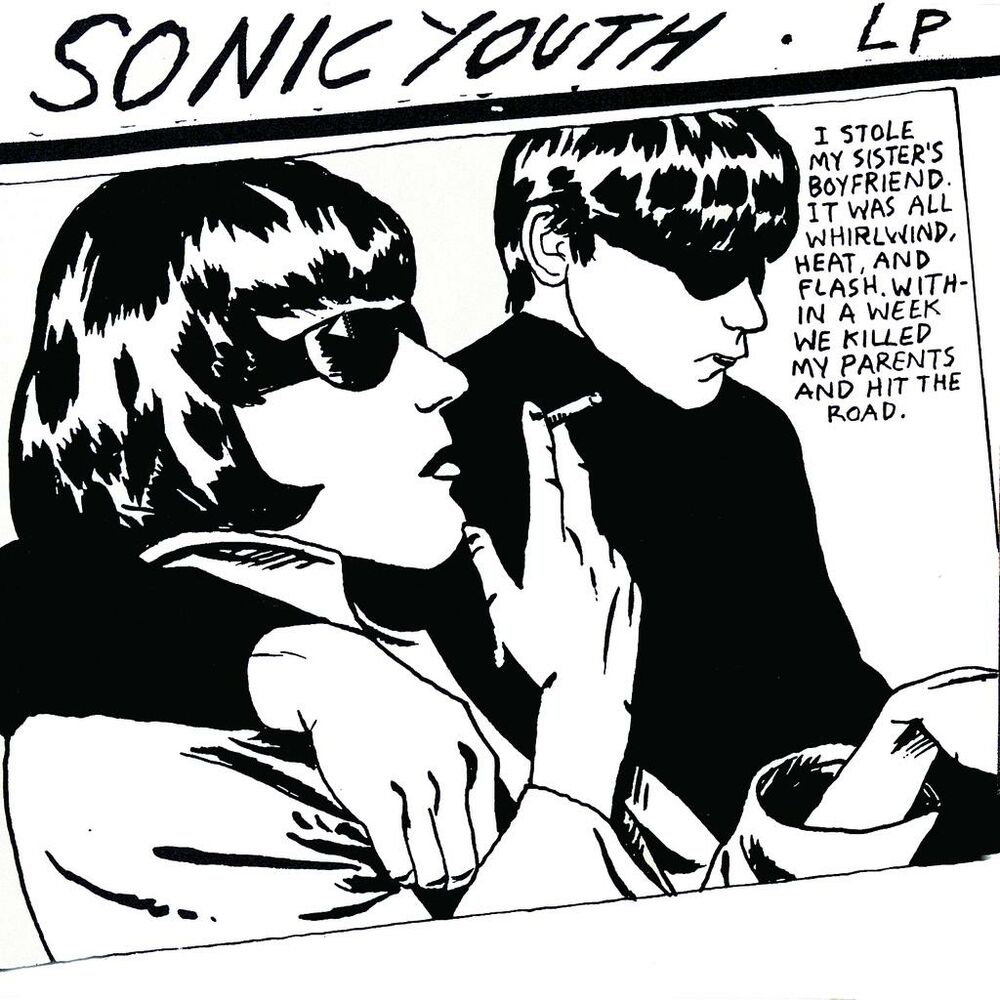
Goo
- Released1 January 1990
- UK peak No. 32
- Weeks on UK chart 2
- Entered UK chart 1 July 1990
- LabelGeffen
- Tracks11 · 50 min
One track from it charted as a single. Press a flag to play it in the chart where it peaked.
Tracks
| 1 | Dirty Boots | 5:24 | |
| 2 | Tunic (Song For Karen) | 6:17 | |
| 3 | Mary-Christ | 3:08 | |
| 4 | Kool Thing No. 81 · 1990 | 4:04 | |
| 5 | Mote | 7:36 | |
| 6 | My Friend Goo | 2:19 | |
| 7 | Disappearer | 5:08 | |
| 8 | Mildred Pierce | 2:12 | |
| 9 | Cinderella's Big Score | 5:52 | |
| 10 | Scooter And Jinx | 1:04 | |
| 11 | Titanium Expose | 6:26 |
About the album
Goo is the sixth full-length studio album by American alternative rock band Sonic Youth, released on June 26, 1990, by DGC Records. The album was the band's major label debut, originally signing with Geffen Records before they were given to DGC, a smaller subsidiary of the label. Coming off the success of Daydream Nation, Nick Sansano returned to engineer Goo, but veteran producer Ron Saint Germain was chosen by Sonic Youth to finish mixing the album following Sansano's dismissal.
Featuring feminist and pop culture-concerned lyrics, the band sought to expand upon its trademark alternating guitar arrangements and the layered sound of their previous album Daydream Nation, with bassist Kim Gordon's role as a vocalist and songwriter expanding in relation to previous albums.
Goo was a critical and commercial success upon its release, peaking at number 96 on the US Billboard 200, their highest chart position to date. Although it lacked significant radio airplay, its lead single "Kool Thing", a collaborative effort with Public Enemy's Chuck D, reached number seven on the Billboard Modern Rock Tracks chart. Since then, Goo has been viewed as one of alternative rock's most important albums, and is considered musically and artistically significant. In 2020, the album was ranked at number 358 on Rolling Stone's 500 greatest albums of all time list.
Background
In 1989, nearly a year after the release of the band's breakthrough album Daydream Nation, Sonic Youth announced that it had signed a recording contract with Geffen Records, the group's first major label deal. Sonic Youth decided to sever relations with its former label, Enigma Records, as a result of the band's displeasure with Enigma's indecisive marketing and distribution of Daydream Nation, as well as "Teen Age Riot"—the album's accompanying single. Another factor that contributed to the group's departure from the label was Enigma's handling of The Whitey Album, an experimental album of sound manipulation and hip-hop influences released under the name Ciccone Youth.
Recording
In November 1989, Sonic Youth, accompanied by producers Don Fleming and J Mascis, recorded demos of eight songs at the Waterworks, a studio run by Jim Waters in the meat-packing district of New York City. Lee Ranaldo recalled Kim Gordon and Thurston Moore were keen on inviting Fleming and Mascis "both as extended family and as people to have an opinion"; both Ranaldo and Steve Shelley were uncomfortable about their presence "because we'd never made records before where there were other people involved". The original working title for the album was Blowjob?, mostly to test the humor of their new label, but ultimately the band was convinced to drop the name in favor of Goo, a title inspired by one of the album's tracks, "My Friend Goo". Because the results of these sessions were later heavily bootlegged, Moore officially released them on the album Goo Demos in 1991.
At engineer Nick Sansano's recommendation, with a sizable budget finally at their disposal, Sonic Youth booked themselves into Sorcerer Sound in early 1990.
Music
Goo expanded upon the alt-rock stylings of Daydream Nation with far more deliberate pop culture references. Another development within the band at the time was Gordon's importance as both a lead vocalist and songwriter. Gordon contributed two songs, "Tunic (Song for Karen)" and "Kool Thing", that challenged the expectations of a woman's role in American society. "Tunic (Song for Karen)", an exploration into self-esteem and body image, traces Karen Carpenter's struggle with anorexia nervosa to her mother's comment that she appeared overweight onstage, and the music industry's rejection of her proposed 1980 solo album. Band biographer Stevie Chick described Gordon's lyrics as "coloured by a suffocating almost gothic sadness" and "melancholy perhaps similar to that which underscores the Carpenters own music".
A second Gordon composition, "Kool Thing", was inspired by her 1989 interview with LL Cool J.
Release
Goo was released by DGC Records on June 26, 1990. The album's front cover design was created by Raymond Pettibon, who was responsible for early covers for Black Flag. Instead of his original Joan Crawford sketch, Sonic Youth chose another Pettibon design: an illustration of two sunglasses-wearing British mods, based on a photograph of Maureen Hindley and David Smith, two witnesses in the Moors murders trial. Although Geffen pushed for a mainstream market, the label also was concerned about alienating Sonic Youth's original fan base. This prompted Geffen executive Mark Kates to attempt grassroots promotional tactics. In promoting Goo, Kates arranged for the band to visit college radio stations and music journalists weeks leading up to the album's release.
The controversy surrounding the album's content and the exposure from the single "Kool Thing" helped Goo exceed the expectations of the group's label. By December 1990, Goo had sold over 200,000 copies and ultimately peaked at No. 96 on the Billboard 200—the band's highest charting album to date.
Reception
Goo received rave reviews from contemporary critics. In an August 1990 article, Rolling Stone's David Fricke viewed the record as Sonic Youth's most accessible work to date. He believed Goo was a "brilliant, extended essay in refined primitivism that deftly reconciles rock's structural conventions with the band's twin passions for violent tonal elasticity and garage-punk holocaust". Jonathan Gold of the Los Angeles Times hailed Sonic Youth as the "Rolling Stones of noise music" and found the band's distorted guitars, danceable rhythms and catchy choruses fit for radio airplay. Select writer Russell Brown felt that the album "bursts with ... a sense of the unexpected" and praised it as "bitchin' good art". In NME, Steve Lamacq concluded that while it "might not be the hippest album, taking into account public taste for US grunge at the moment", Goo "is still a defiant alternative".
Legacy
Since Goo was first released, it has been viewed as one of the greatest and most important alternative rock records of all time, as well as a culturally significant work. Alec Foerge cited it as "radical—even defiant by 1990 major label standards" while David Browne said the album's success was "an indication that an audience for this music was coalescing, albeit slowly". Daisy Jones of Dazed found the album powerfully relevant to American youth: "It sprung out of 1990, the year in which grunge had spread like an itch amongst a generation increasingly disillusioned with the mock-metal and stadium theatrics of artists like Guns N' Roses and Alice Cooper".