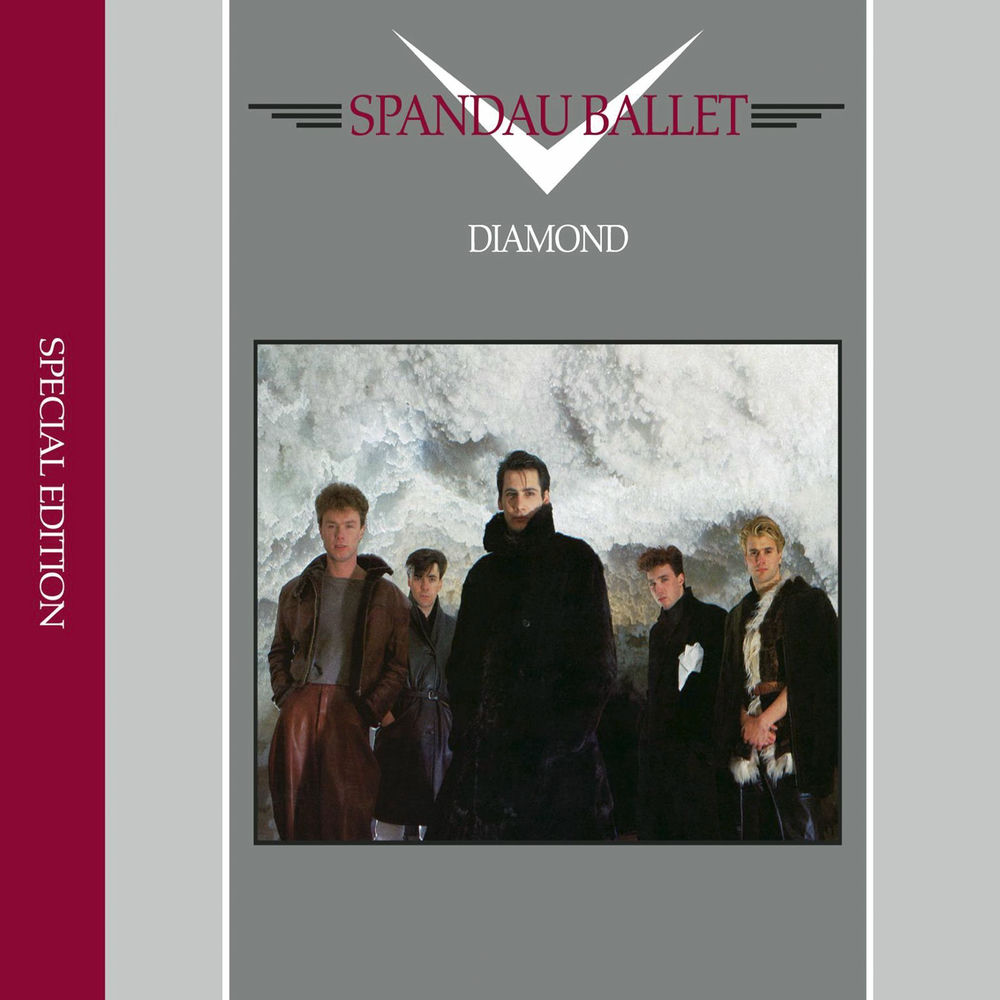
Diamond (Special Edition)
- Released25 May 1982
- UK peak No. 15
- Weeks on UK chart 17
- Entered UK chart 14 March 1982
- LabelParlophone UK
- Tracks25 · 131 min
6 tracks from it charted as singles. Press a flag to play it in the chart where it peaked.
Tracks
| 1 | Chant No. 1 (I Don't Need This Pressure On) (2010 Remaster) No. 3 · 1981 | 4:09 | |
| 2 | Instinction (2010 Remaster) No. 10 · 1982 | 4:51 | |
| 3 | Paint Me Down (2010 Remaster) No. 30 · 1981 | 3:47 | |
| 4 | Coffee Club (2010 Remaster) | 5:36 | |
| 5 | She Loved Like Diamond (2010 Remaster) No. 49 · 1982 | 2:54 | |
| 6 | Pharaoh (Remix; 2010 Remaster) | 6:37 | |
| 7 | Innocence and Science (Remix; 2010 Remaster) | 4:27 | |
| 8 | Missionary (Remix; 2010 Remaster) | 7:03 | |
| 9 | Chant No. 1 (I Don't Need This Pressure On) (Remix; 2010 Remaster) No. 3 · 1981 | 8:04 | |
| 10 | Instinction (Remix; 2010 Remaster) No. 10 · 1982 | 6:58 | |
| 11 | Paint Me Down (Remix; 2010 Remaster) No. 30 · 1981 | 6:24 | |
| 12 | Coffee Club (Remix; 2010 Remaster) | 6:48 | |
| 13 | She Loved Like Diamond (Remix; 2010 Remaster) No. 49 · 1982 | 3:41 | |
| 14 | Feel the Chant (7" Version; 2010 Remaster) | 4:06 | |
| 15 | Man with Guitar (2010 Remaster) | 2:52 | |
| 16 | Gently (2010 Remaster) | 4:00 | |
| 17 | Chant No. 1 (I Don't Need This Pressure On) (12" Version; 2010 Remaster) No. 3 · 1981 | 5:52 | |
| 18 | Feel the Chant (12" Version; 2010 Remaster) | 5:49 | |
| 19 | Paint Me Down (12" Version; 2010 Remaster) No. 30 · 1981 | 7:05 | |
| 20 | Re-Paint (2010 Remaster) | 6:57 | |
| 21 | Instinction (12" Version; 2010 Remaster) No. 10 · 1982 | 3:40 | |
| 22 | The Freeze (BBC In Concert, Bournemouth, 10/4/82) No. 17 · 1981 | 5:12 | |
| 23 | To Cut A Long Story Short (BBC In Concert, Bournemouth, 10/4/82) No. 5 · 1980 | 3:51 | |
| 24 | Glow (BBC In Concert, Bournemouth, 10/4/82) | 5:14 | |
| 25 | Paint Me Down (BBC In Concert, Bournemouth, 10/4/82) No. 30 · 1981 | 4:46 |
About the album
Diamond is the second studio album by the English band Spandau Ballet, released on 12 March 1982 by Chrysalis Records. As with their debut album, Journeys to Glory, all songs were produced by Richard James Burgess and written by band guitarist Gary Kemp. The music was inspired by a variety of genres, including the renewed interest in funk around Soho, American film scores with roots in eastern Europe, the second side of David Bowie's Low album, Pink Floyd records and the mood pieces of another English new wave band, Japan.
Burgess, Kemp and lead singer Tony Hadley had difficulties over the course of making the album. After the first song written for it, "Chant No. 1 (I Don't Need This Pressure On)", became the band's biggest hit, Kemp found it harder to churn out material to complete the project. Burgess began to exercise control over Hadley, who struggled with the vocals to the point of losing his temper and needing to take some time off.
Background and development
By the time Spandau Ballet had completed their first album, Journeys to Glory, their guitarist/songwriter Gary Kemp found that musical tastes around Soho were shifting toward funk. This eventually inspired him to write "Chant No. 1 (I Don't Need This Pressure On)", which became a number 3 hit on the UK Singles Chart in the summer of 1981 and the first song completed for Diamond. Its success added to the stress Kemp was already experiencing in having to write enough material to fill an album. In his autobiography I Know This Much: From Soho to Spandau, he wrote, "Unlike second marriages, second albums are notoriously difficult. Journeys had been developed over some time and played live before we went into the recording studio, with some songs being discarded at the last minute. It was a mission statement, cohesive and tight, with none of the indulgence that often plagues follow-ups."
Recording
Lead singer Tony Hadley had found himself more and more isolated from the other band members during the time that they traveled to promote their first album, and that isolation was only compounded as he had difficulty performing the vocals for Diamond while the band watched him through the glass from the control room; he attributed his struggle to the fact that he disliked several of the songs and felt his confidence was gone. Spandau Ballet chose to continue working with Journeys to Glory producer Richard James Burgess on Diamond, the recording of which was prolonged because of the need to use several different studios in order to accommodate Burgess's schedule. Hadley was especially frustrated during the making of the album because of an escalating friction between him and Burgess, which began while recording "Chant No. 1"; although the music sessions went well, according to Kemp, Burgess wanted Hadley's voice to convey the "film noir quality of the lyrics by having Tony sing it quietly, restrained, and with a sense of paranoia.
Critical reception
Although most reviews at the time of its release were negative, some critics gave Spandau Ballet credit for doing something different. Billboard magazine wrote that, whereas Journeys to Glory "was too similar from track to track, this one shows the band moving in new directions. The experimentation is not always successful, notably on side two," where Kemp attempted a mix of film music and progressive rock. Mike Nicholls of Record Mirror had mixed feelings about that side, especially with regard to the album's closer, "Missionary": "At best its eastern chants and listless sitar show Spandau entering new avenues." He also noted that "'Innocence and Science' has an obviously Oriental flavour, Gary Kemp trying his chops at 'cheng', which, in conjunction with the lapping water effects provides a quaintly Floydian 'Grantchester Meadows' atmosphere." In concluding he warned that "the band have become victims of their obsessive stylization, and unless they break free from their neurotic need to be super-hip, they will soon stagnate beyond the point of no return." Red Starr of Smash Hits tho
Singles and videos
The number 3 showing of "Chant No. 1 (I Don't Need This Pressure On)" on the UK Singles Chart was the highest peak position Spandau Ballet had achieved at that point. It also reached the pop charts in Australia, Ireland, the Netherlands, New Zealand and Spain, and in the U.S. the 12-inch remix of the song charted on Billboard magazine's Disco Top 100. The music video showed the band performing the song at Le Beat Route. Although Cook disliked the box-set version, "Chant No. 1" otherwise received positive reviews. Smash Hits magazine called it "their best effort to date", Paul Lester of BBC Online described it as "a revolutionary white-funk record", and in The Independent, Dylan Jones proclaimed it "one of the most important records of the early Eighties".
The peak at 30 in the UK for "Paint Me Down" was their worst chart performance there to date. Critics were differing in their opinions, with Smash Hits labeling it "cringeworthy" and Dan LeRoy of AllMusic calling it "tuneless" while that site's Dave Thompson thought it "represented the peak of Spandau's ambition".
Commercial performance
Diamond was released on 12 March 1982, five months after the band had finished recording it. In an interview with New Sounds New Styles magazine in May of that year, Kemp was asked why it took so long to get the album finished and in stores and responded, "Oh, just record company rubbish. It always seems to happen – trouble with the artwork. Things like that." On 20 March Diamond began 17 weeks on the UK Albums Chart, during which time it reached number 15. It also charted at number 9 in New Zealand, number 22 in Sweden, number 39 in Australia and number 40 in Canada.
The British Phonographic Industry awarded the album Silver certification on 30 April of that year and Gold certification 8 months later, on 9 December, for reaching the respective 60,000 and 100,000 units of shipment thresholds.
Aftermath
When the Horn remix of "Instinction" started to become popular with radio DJs, Kemp met with Burgess to communicate Spandau Ballet's decision to move on to another producer for future projects. As the band prepared for their next album later that year, Kemp told Smash Hits, "We moved away from Richard because we didn't want to get in a rut." In a 1986 interview with Billboard magazine, Burgess said that he was also ready to move on because the amount of remixing required for the Diamond box set in addition to the 7- and 12-inch single mixes left him exhausted.
The success of "Instinction" as a full-fledged pop song also confirmed Kemp's belief that the original followers of Spandau Ballet would no longer be interested in their music. He now felt free to write in whatever style he chose without worrying about how it would play to the London club scene. Horn was especially interested in one of the first songs he came up with, which was called "Pleasure".