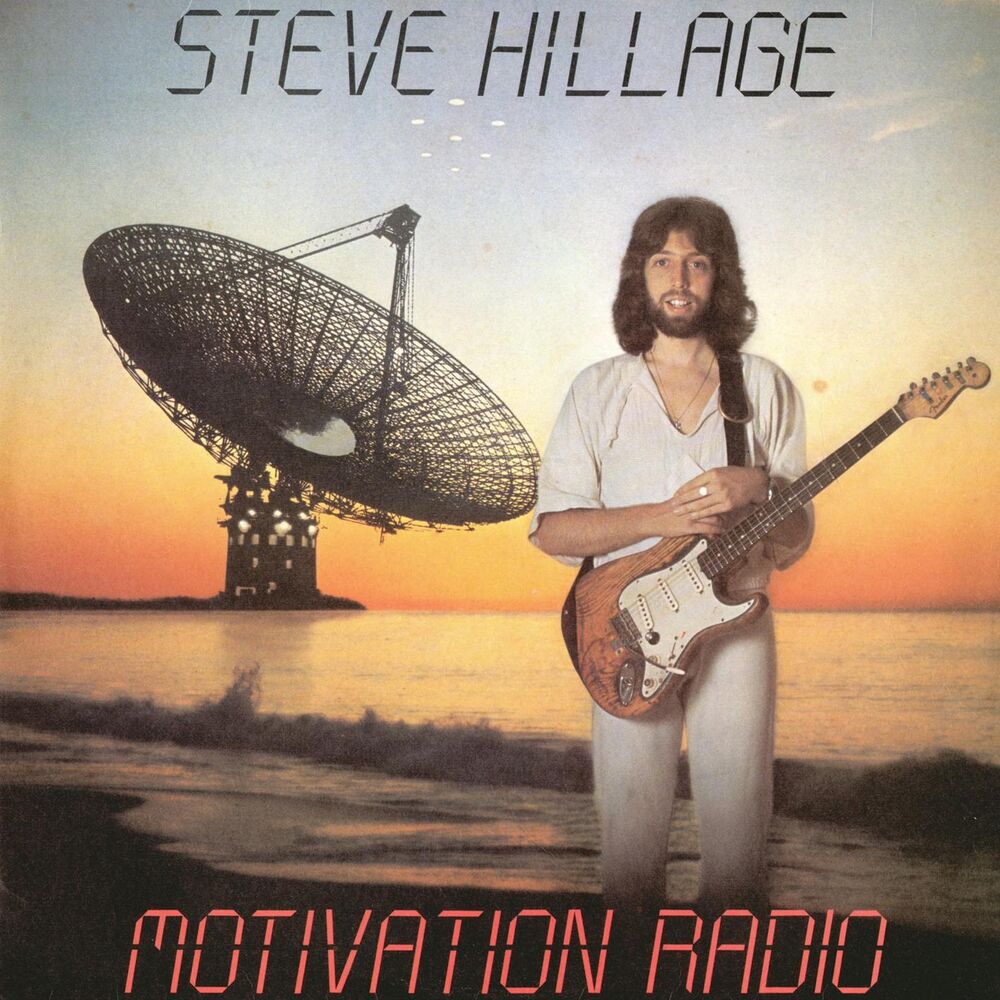
Motivation Radio
- Released31 October 2006
- UK peak No. 28
- Weeks on UK chart 5
- Entered UK chart 16 October 1977
- LabelVirgin Catalogue
- Tracks12 · 53 min
Tracks
| 1 | Hello Dawn (2006 Digital Remastered) | 2:49 | |
| 2 | Motivation (Remastered) | 4:10 | |
| 3 | Light In The Sky (2006 Digital Remastered) | 4:11 | |
| 4 | Radio (2006 Digital Remastered) | 6:13 | |
| 5 | Wait One Moment (2006 Digital Remastered) | 3:19 | |
| 6 | Saucer Surfing (2006 Digital Remastered) | 4:20 | |
| 7 | Searching For The Spark (2006 Digital Remastered) | 5:31 | |
| 8 | Octave Doctors (2006 Digital Remastered) | 3:33 | |
| 9 | Not Fade Away (Glide Forever) (2006 Digital Remastered) | 3:29 | |
| 10 | Leylines To Glassdom (T.O.N.T.O Version; 2006 Digital Remastered) | 2:47 | |
| 11 | The Salmon Song (Power Trio Backing Track) (2006 Digital Remastered) | 9:03 | |
| 12 | The Golden Vibe (Alternative Mix; 2006 Digital Remastered) | 3:28 |
About the album
Motivation Radio is the third studio album by British progressive rock musician Steve Hillage, released by Virgin Records in September 1977.
Whilst touring in the United States in promotion of his previous album L (1976), Hillage grew disillusioned with the progressive rock tag attached to him by the media and fans, and disliked their attitude towards funk music, which Hillage was a big fan of. Hillage wanted to create a funk-influenced album as he was predominately listening to artists such as Funkadelic and Earth, Wind & Fire. Originally written as The Red Album in early 1977, it was retitled Motivation Radio prior to recording.
Hiring electronic innovator Malcolm Cecil, formerly of the pioneering Tonto's Expanding Head Band, to produce and engineer the album, Motivation Radio introduces Hillage's new rhythm section of drummer Joe Blocker and bassist Reggie McBride and was primarily recorded in Los Angeles, California in July 1977. The album presents a much more funk and dance-orientated sound than his previous albums, and relies more so on synthesizers, including T.O.N.T.O. (The Original New Timbral Orchestra), Cecil's large handbuilt polyphonic synthesizer, the first of its kind, that Cecil had played with the Expanding Head Band as he does here.
Background
Hillage's second album, the Todd Rundgren-produced L (1976), had proven to be his biggest commercial success to date, entering the UK Albums Chart on 16 October 1976, where it stayed for 12 weeks, hitting a peak of number 10. The success of L was largely due to the fact that Hillage had formed a band to promote the album in concert, extensively touring England and France for the remaining months of 1976. The concerts were well attended and well received, and news that L was also selling strongly in the United States led to Hillage and his band opening for Electric Light Orchestra on their 1977 tour of the United States. Hillage recalled that "the reaction we got was very encouraging and we went down well."
During his time in the United States, Hillage was seen by the media as "another" English progressive rock artist, much to Hillage's dislike. Hillage explained "I did have mixed feelings about the perception that surrounded my music," adding that "I must admit I never liked the term 'progressive rock'. I felt it never applied to Gong and it certainly never applied to me either.
Music
Presented as "a multidimensional window," music writer Mark Powell noted that, true to Hillage's wishes, Motivation Radio was "funkier in nature" than his previous material, although "still undeniably Hillage." Inspired by funk, disco and dance music, Motivation Radio sees Hillage extensively employing the synthesiser for the first time, as well as a guitar technique that gives much of the music here a mystical atmosphere. Hillage recalled that Motivation Radio was "the moment where the dance/funk thing began to manifest itself and even then that came out of an unusual and interesting experience."
Although the album is more dance-orientated than previous works, it still features Hillage's trademark glissando guitar work at its core.
Release
The album's cover features Hillage standing on a shoreline holding a Stratocaster guitar, with the radio telescope at Parkes Observatory superimposed in the background. Hillage's father bought him the Stratocaster because Steve went to a public school - the City of London School - and "did quite well" on his O levels and won a scholarship, meaning that his father did not have to pay fees any more. Hillage recalled that "We found it through Exchange & Mart or Melody Maker - one or the other, I don't know." American art director Bob Cato is credited on the album sleeve for "design and photography."
Promoted with a magazine advertisement featuring the slogan "Get Motivated," Motivation Radio was released as an LP and cassette by Virgin Records in most regions in September 1977, with release in other countries such as Yugoslavia following in January 1978. The album entered the UK Albums Chart on 22 October 1977, where it stayed for 5 weeks, hitting a peak of number 28. This was significantly lower than L, which peaked at number 10.
Critical reception
Despite the relative commercial failure of Motivation Radio, it received enthusiastic reviews from music critics, and, according to music writer Mark Powell, "did much to enhance Steve Hillage's reputation as an innovative musician." A magazine advertisement for the album noted that critics had called it "the best guitarist's album so far this year." Billboard were favourable, saying that "Hillage's powerful guitar powers its way through each cut as the synthesizer evokes the hypnotics" and singling out "Radio", "Motivation", "Searching for the Spark" and "Saucer Surfing" as the album's "best cuts." Phil Sutcliffe of Sounds magazine also wrote a review despite being heavily preoccupied with punk rock at the time.
In later times, the album has been increasingly acclaimed.
Aftermath and legacy
To coincide with the release of Motivation Radio, a new-line up of Steve Hillage's band featuring Blocker on drums, Curtis Robinson Jr on bass guitar and Chuck Bynum on keyboards and synths toured throughout the UK and Europe in late 1977, ending with a performance at The Rainbow in London on 3 November. The band were then due to tour America, but the tour was abandoned after the album's commercial failure, freeing the band to record again. For the subsequent album Green (1978), he recorded the material he had written alongside Motivation Radio in early 1977, originally intended to be released as The Green Album alongside The Red Album, before the latter album became Motivation Radio.