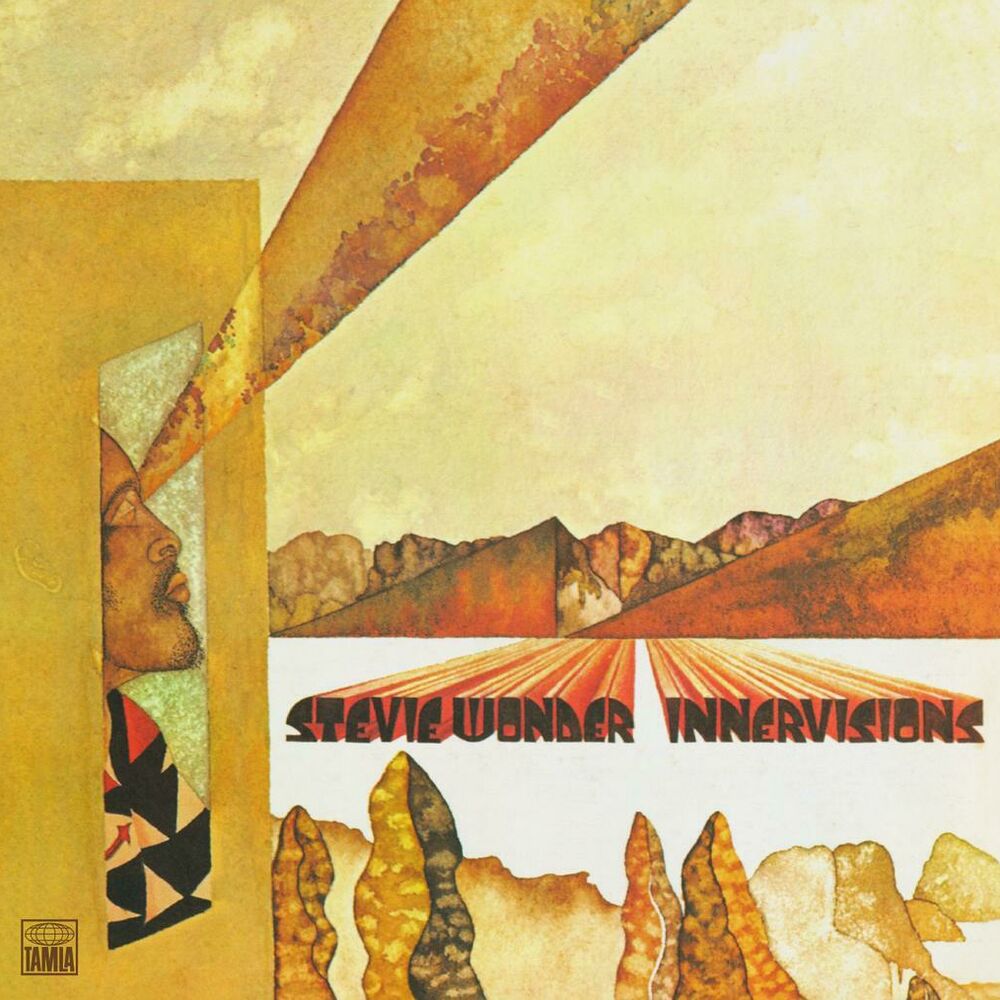
Innervisions
- Released3 September 1973
- UK peak No. 8
- Weeks on UK chart 55
- Entered UK chart 26 August 1973
- LabelMotown
- Tracks9 · 44 min
4 tracks from it charted as singles. Press a flag to play it in the chart where it peaked.
Tracks
| 1 | Too High | 4:36 | |
| 2 | Visions | 5:23 | |
| 3 | 7:23 | ||
| 4 | Golden Lady | 4:55 | |
| 5 | 3:42 | ||
| 6 | Jesus Children Of America | 4:10 | |
| 7 | All In Love Is Fair | 3:42 | |
| 8 | Don't You Worry 'Bout A Thing No. 16 · 1974 | 4:45 | |
| 9 | He's Misstra Know-It-All No. 10 · 1974 | 5:36 |
About the album
Innervisions is the sixteenth studio album by American singer, songwriter, and musician Stevie Wonder, released on August 3, 1973, by Tamla, a subsidiary of Motown Records. A landmark recording of Wonder's "classic period", the album has been regarded as completing his transition from the "Little Stevie Wonder" known for romantic ballads into a more musically mature, conscious, and grown-up artist.
On Innervisions, Wonder continued to experiment with the revolutionary T.O.N.T.O. (The Original New Timbral Orchestra) synthesizer system developed by Malcolm Cecil and Robert Margouleff. Wonder's previous two albums, 1972’s Music of My Mind and Talking Book, boosted his standing in the music industry, transforming him from a reliable hitmaker into a "master" of the new album format. Ahead of Innervisions, Cecil and Margouleff were pushing Wonder to shift his lyrical themes, allowing for political and metaphysical issues to be discussed in his music instead of primarily singing about romance. The album's second single, “Living for the City” is considered its centerpiece.
Innervisions peaked at number four on the Billboard Top LPs & Tape chart and number one on the Billboard Soul LPs chart. At the 16th Grammy Awards, it won Album of the Year and Best Engineered Non-Classical Recording, while "Living for the City" won Best R&B Song.
Recording
As with many of Wonder's albums, the lyrics, composition, and production of Innervisions are almost entirely his own work, and he also played all, or virtually all, the instruments on many of the album's tracks. He made prominent use of synthesizers throughout the album.
The nine tracks of Innervisions encompass a wide range of themes and issues: from drug abuse in "Too High", through inequality and systemic racism in "Living for the City", to love in the ballads "All in Love Is Fair" and "Golden Lady". The album's closer, "He's Misstra Know-It-All", is thought by some to be a scathing attack on then-US President Richard Nixon, similar to Wonder's song "You Haven't Done Nothin'" from the following year.
Critical reception
As with both Music of My Mind and Talking Book from the previous year, Innervisions was received warmly by music critics, many of whom praised Wonder's versatile musical skills. Billboard wrote that "the liner credits Stevie with playing all the instruments on seven of the nine tunes. So in essence this is a one-man band situation and it works. His skill on drums, piano, bass, and ARP synthesizers are outstanding, and all the tracks work within the thematic framework." (Two ARP synthesizers were incorporated into the T.O.N.T.O. system.) The New York Times said: "At the center of his music is the sound of what is real. ... Stevie identifies himself as a gang and a genius, producing, composing, arranging, singing and, on several tracks, playing all the accompanying instruments. ... Vocally, he remains inventive and unafraid, he sings all the things he hears: rock, folk and all forms of Black music.
Commercial performance
Following Talking Book, which hit the top 5 of the Billboard albums chart in early 1973 and achieved steady sales throughout the rest of the year, Innervisions became another considerable hit on the charts for Wonder. It debuted on the Billboard albums chart on August 18, 1973, at number 85, then climbed to number 22, number 14, number nine, and number six, before reaching its peak position of number four on September 22. The album remained in the top 20 until June 22, 1974, and remained in the top 200 during the entire calendar year of 1974, falling off the Billboard albums chart week ending January 11, 1975. Innervisions was Wonder's second consecutive album to reach the top of the Billboard Black Albums chart, where it remained for two weeks. On the Cashbox chart, it reached number one near the end of 1973. In the UK, the album also found success, and became Wonder's first to reach the UK top 10, peaking at number eight.
Three hit singles were issued from the album.
Legacy
Innervisions continued to attract critical praise after its initial chart run. The Washington Post critic Geoffrey Himes called it an exemplary release of the progressive soul development from 1968 to 1973. The album has been regarded as completing his transition from the "Little Stevie Wonder" known for romantic ballads into a more musically mature, conscious, and grown-up artist. In his Rock & Roll Review: A Guide to Good Rock on CD (1991), Bill Shapiro wrote: "This recording represents the pinnacle of a very important artist's career, and of his physically blind, but nonetheless extraordinary humane vision. ... The feel is a little more jazz than funk, the result is simply glorious pop music – uplifting sound and message."
The album has been included on many lists of the greatest albums of all time. It was voted number 143 in the third edition of Colin Larkin's All Time Top 1000 Albums (2000).