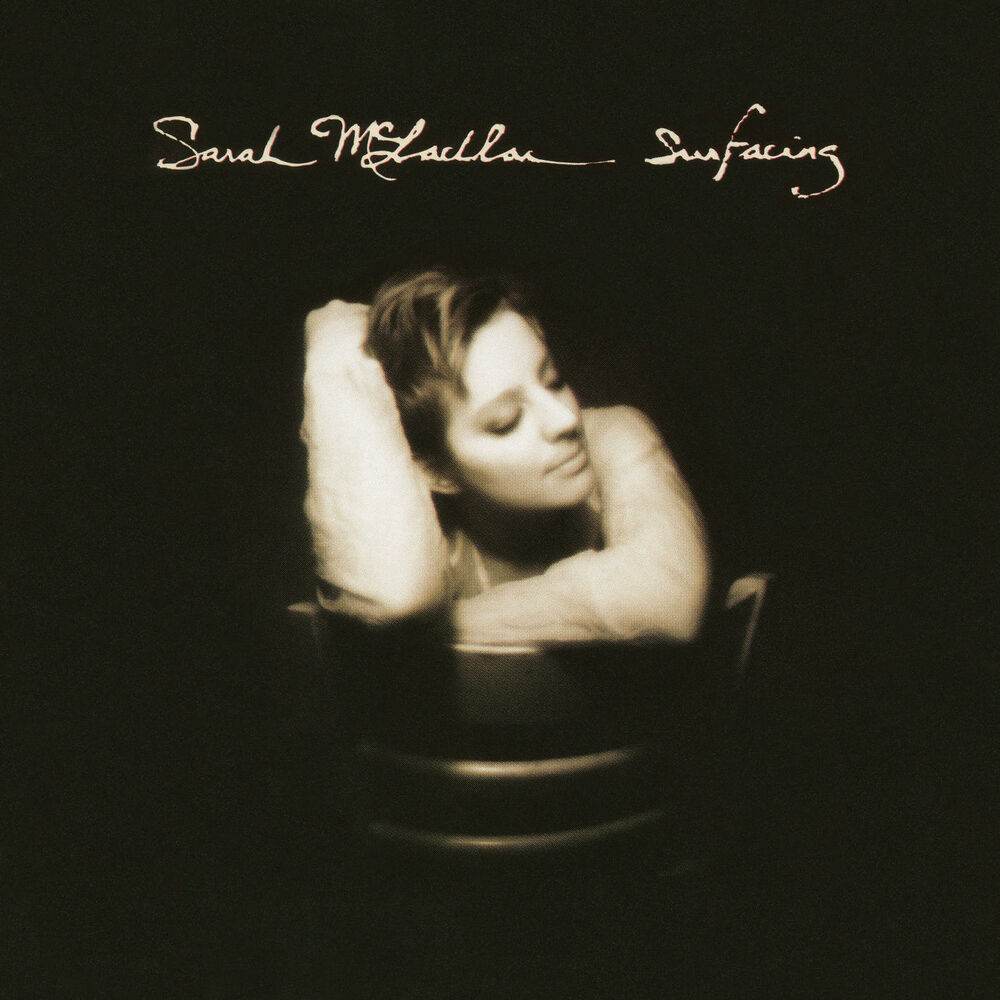
Surfacing
- Released15 July 1997
- UK peak No. 47
- Weeks on UK chart 4
- Entered UK chart 27 September 1998
- LabelArista
- Tracks10 · 41 min
4 tracks from it charted as singles. Press a flag to play it in the chart where it peaked.
Tracks
| 1 | Building a Mystery No. 13 · 1997 | 4:07 | |
| 2 | I Love You | 4:44 | |
| 3 | Sweet Surrender No. 28 · 1998 | 4:00 | |
| 4 | 4:05 | ||
| 5 | Do What You Have to Do | 3:47 | |
| 6 | Witness | 4:45 | |
| 7 | 4:30 | ||
| 8 | Black & White | 5:02 | |
| 9 | Full of Grace | 3:41 | |
| 10 | Last Dance | 2:33 |
About the album
Surfacing is the fourth studio album by Canadian singer-songwriter Sarah McLachlan, released on 15 July 1997. It was produced by McLachlan's frequent collaborator, Pierre Marchand, and its release coincided with the start of McLachlan's Lilith Fair tour. The album reached the top position on the Canadian RPM 100 Albums chart, number two on the US Billboard 200 and became her first album to reach the top 50 outside of North America, achieving that in the UK, Australia and the Netherlands. It was certified as Diamond in sales in Canada and as 8× Platinum in sales in the US. Critical reviews were mixed; some of the more positive reviews praised the songwriting, while the album's detractors criticized it as banal and slow.
The album spawned three top-three hits on the Canadian Singles Chart, including "Building a Mystery", which spent eight weeks at number one, "Sweet Surrender", which reached number two, and "Adia" which ascended to number three. The fourth single "Angel" peaked at number nine, but did reach number three on the Canadian Adult Contemporary Chart, something the other three singles also achieved. Two of the songs, "Adia" and "Angel" were US Billboard Hot 100 top-five hits (the latter also peaking at number one on the Billboard Adult Contemporary Chart) while "Building a Mystery" was a top-15 hit and "Sweet Surrender" was a top-30 hit.
Background
Following the 1993 release of her third album and U.S. breakthrough, Fumbling Towards Ecstasy, McLachlan spent two and a half years touring. This long period on the road finished in January 1996; over this time, the album slowly became a hit record. Work on the follow-up was scheduled to begin in April of that year, but McLachlan found herself mentally exhausted at the time, later claiming that she had personally wanted Fumbling Towards Ecstasy to be her final record. She spent time working in the studio in Quebec but struggled to produce anything for her new album. At her manager's suggestion, she returned home to Vancouver and took six months off. She said that after this break—and some time spent in therapy—she began to feel more in control of her creativity and started writing material for the album.
One of the first songs written for the album was the hit single "Angel".
Recording and release
Like most of McLachlan's albums, Surfacing was recorded at Marchand's Wild Sky Studios in Morin-Heights, Quebec. Marchand, who produced, engineered, and mixed the album, recorded it on an Otari RADAR recorder and a Neumann 149 microphone. McLachlan played piano, acoustic guitar, and electric guitar and Marchand played keyboards, bass, and a drum machine as well as providing background vocals. The other musicians on the album were Jim Creeggan on upright bass, Yves Desrosiers on guitar, musical saw, lap steel guitar and slide bass, Brian Minato on bass and electric guitar, Michel Pepin on electric guitar, and Ashwin Sood (whom McLachlan married in 1997) on percussion and drums.
The album was released on 15 July 1997, on Nettwerk and Arista Records, debuting at No. 1 on the Canadian RPM 100 Albums chart, its lone week on top of the chart. It peaked at No. 2 on the US Billboard 200. It also reached the top 15 in New Zealand, the top 40 in Australia, and the top 50 in the UK and the Netherlands, her first album to chart in all of those countries.
Critical reception
Writing for The New York Times, Sia Michel called the album "lushly atmospheric" but also ambivalent. She said that while the album paints a "vivid emotional landscape", it is at odds with McLachlan's statement that the album was about "'facing ugly things' about herself"; not revealing anything particularly dark. Michel also noted certain old-fashioned ideas in the album, particularly in "Sweet Surrender", that contrast with the work of contemporaries such as Ani DiFranco and PJ Harvey. She cited "Witness" as the highlight and said of the album, "[p]erhaps she hasn't found what she's looking for, but at least she's trying." Elysa Gardner of Los Angeles Times said it "showcases her considerable strengths—a shimmering soprano voice and a knack for intelligent, emotionally forthright lyrics but also suffers from a lack of compelling craftsmanship and textural daring."
Music critic Robert Christgau wrote that although he had stayed away from McLachlan's music in the past, "between her Lilith Fair counterpalooza and 'Building a Mystery' bonanza, [he] had to dive in, and got less than [he