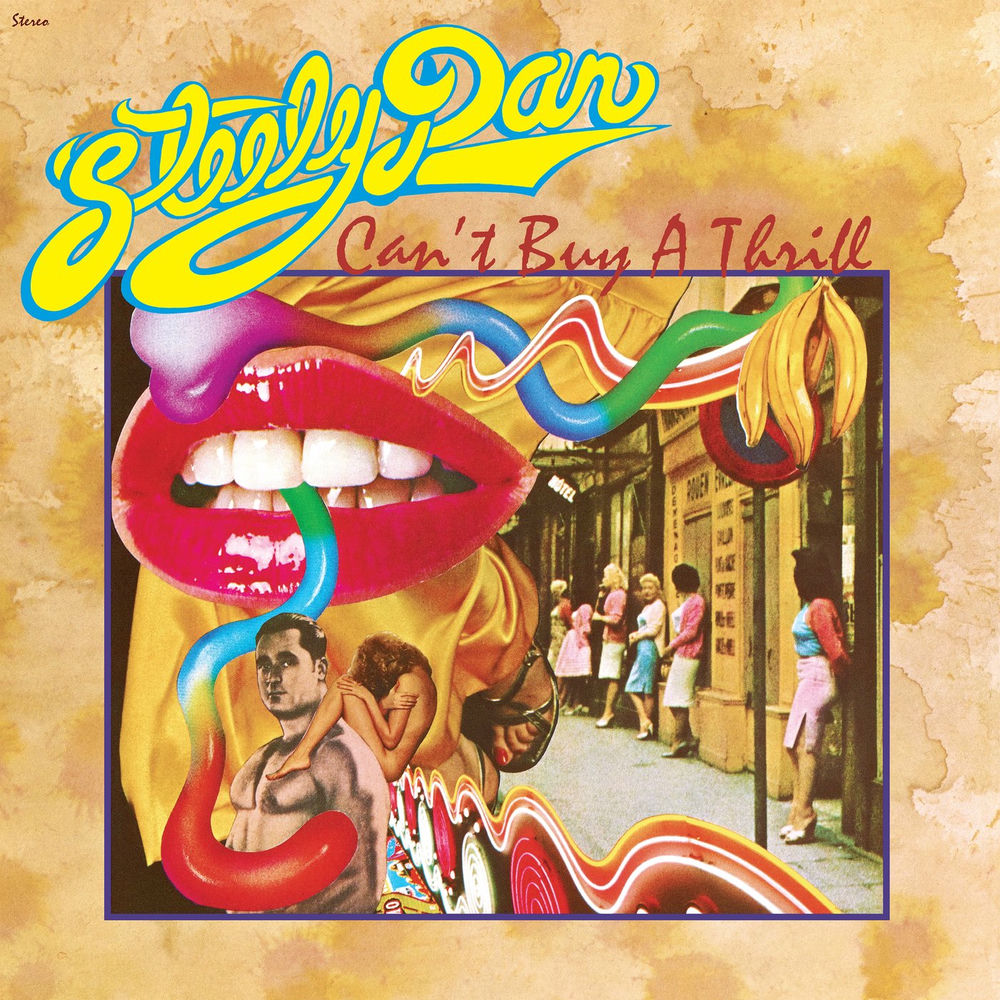
Can't Buy A Thrill
- Released1 January 1972
- UK peak No. 38
- Weeks on UK chart 1
- Entered UK chart 14 September 1975
- LabelGeffen
- Tracks10 · 41 min
One track from it charted as a single. Press a flag to play it in the chart where it peaked.
Tracks
| 1 | 5:54 | ||
| 2 | Dirty Work | 3:08 | |
| 3 | Kings | 3:45 | |
| 4 | Midnite Cruiser | 4:05 | |
| 5 | Only A Fool Would Say That | 2:57 | |
| 6 | Reelin' In The Years | 4:36 | |
| 7 | Fire In The Hole | 3:26 | |
| 8 | Brooklyn (Owes The Charmer Under Me) | 4:19 | |
| 9 | Change Of The Guard | 3:38 | |
| 10 | Turn That Heartbeat Over Again | 4:58 |
About the album
Can't Buy a Thrill is the debut studio album by American rock band Steely Dan, released in November 1972, by ABC Records. It was written by band members Walter Becker and Donald Fagen, and recorded in August 1972 at the Village Recorder in Los Angeles with producer Gary Katz. The album is one of Steely Dan's most stylistically eclectic, encompassing the sounds of soft rock, pop rock and jazz rock, alongside philosophical, elliptical lyrics.
A commercial success, Can't Buy a Thrill peaked at number 17 on the US Billboard Top LPs & Tape chart, bolstered by the popular singles "Do It Again" and "Reelin' In the Years", and was eventually certified platinum by the Recording Industry Association of America (RIAA). It was also met with positive reviews and has appeared on many retrospective "greatest albums" lists, including Rolling Stone magazine's "500 Greatest Albums of All Time" (2003).
Background and recording
After Steely Dan's debut single "Dallas" was withdrawn due to being unrepresentative of their style, ABC Records executives decided to proceed with recording sessions for their first album. The sessions were scheduled for the summer of 1972, but Steely Dan postponed them until engineer Roger Nichols could return from his summer vacation, as they considered him a key part of the project. This annoyed ABC Dunhill's president, Jay Lasker, but A&R man Steve Barri convinced Lasker that Steely Dan were worth the time and expense.
Steely Dan recorded the album in August 1972 at the Village Recorder in Los Angeles. All of the songs were written by Walter Becker and Donald Fagen, Steely Dan's bassist and keyboardist respectively; the liner notes identify "Do It Again" as a traditional song, but this is a fabrication. When the sessions began, Steely Dan was a five-person band, with Fagen handling most of the lead vocals.
Music and lyrics
According to writers Marjorie Galen and Gordon Matthews, Can't Buy a Thrill features an upbeat soft rock style. Music journalist Paul Lester said it incorporates mambo, swing, jazz, and Latin musical elements. Music critic Stephen Thomas Erlewine noted that "there are very few of the jazz flourishes that came to distinguish their [later] albums", but added that the first single from the album, "Do It Again", incorporates a tight Latin jazz beat, while the second single, "Reelin' In the Years", features jazzy guitar solos and harmonies. Steely Dan biographer Anthony Robustelli echoed Erlewine's analysis, saying Can't Buy a Thrill "is arguably their most rock 'n' roll album, and while the songs hint at their jazz leanings, it is the work of a band still trying to find itself. The songs are eclectic, with Latin-flavored rhythms, all-out rockers, ballads, and bluesy workouts ..."
Robert Christgau described "Do It Again" as a toned-down mambo song with "tragic" lyrics about a "compulsive" loser.
Title and packaging
Music historians generally agree that the title of the album is a reference to the opening lines of the Bob Dylan song "It Takes a Lot to Laugh, It Takes a Train to Cry", though Donald Fagen has said the title came from a comment Walter Becker made in a conversation with him: "You can't buy a thrill in California."
The original idea for the album cover was a photo of a young girl looking into a pornography shop as the owner leers at her from inside, but though the photo shoot was held, this idea was eventually rejected. Steely Dan's second choice for the cover was a still from Irma la Douce (a 1963 film about a prostitute), but they were unable to navigate the copyright issues. The third attempt was a photomontage by Robert Lockart. It includes images of muscle-men and a line of prostitutes (standing in Rue du Gros-Horloge in Rouen, France). The band members immediately disliked it, but there was not enough time left to try out yet another cover idea, so the Lockart collage was chosen for lack of a better alternative.
Release
Can't Buy a Thrill was released in the United States by ABC Records in November 1972, and in the United Kingdom by Probe Records in January 1973. The album was released in a two-channel stereo mix, as well as in a four-channel quadraphonic mix.
The album peaked at number 17 on the Billboard Top LPs & Tape chart, and Dunhill Records reissued the album in the U.S. on August 22, 1973. On May 31, 1973, Can't Buy a Thrill was certified Gold by the Recording Industry Association of America (RIAA), recognizing the shipment of 500,000 copies in the U.S.; it was certified Platinum on September 7, 1993, recognizing the shipment of 1,000,000 copies.
Critical reception
Reviewing the album in November 1972 for Rolling Stone, James Isaacs said Can't Buy a Thrill is "distinguished by three top-level cuts and scattered moments of inspiration," but felt the band occasionally sounded "limp". In his review for Creem, Robert Christgau deemed the package "A hit single with a good album attached", and said he found the lyrics "oblique, even philosophical [...] as befit a band named after a dildo in a William Burroughs novel." In Christgau's Record Guide: Rock Albums of the Seventies (1981), Christgau expounded on his original praise, writing: "Think of the Dan as the first post-boogie band: the beat swings more than it blasts or blisters, the chord changes defy our primitive subconscious expectations, and the lyrics underline their own difficulty—as well as the difficulty of the reality to which they refer—with arbitrary personal allusions, most of which are ruses."
In a retrospective review for BBC Music, Paul Lester said the album is so "fully-formed [...] that you would scarcely believe that it's their debut", and contains "tightly constructed songs with