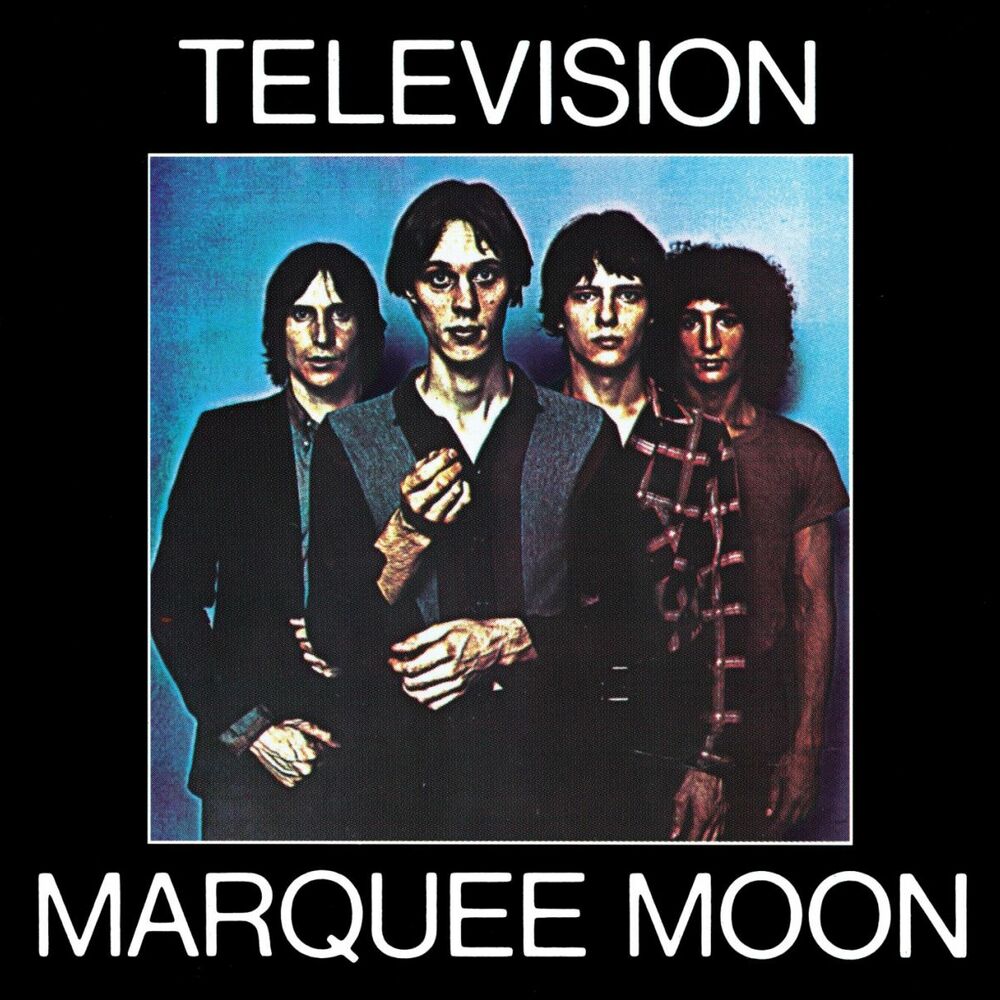
Marquee Moon
- Released24 June 1994
- UK peak No. 28
- Weeks on UK chart 13
- Entered UK chart 20 March 1977
- LabelElektra Records
- Tracks8 · 46 min
2 tracks from it charted as singles. Press a flag to play it in the chart where it peaked.
Tracks
| 1 | See No Evil | 3:52 | |
| 2 | Venus | 3:49 | |
| 3 | Friction | 4:43 | |
| 4 | Marquee Moon No. 30 · 1977 | 10:38 | |
| 5 | Elevation | 5:05 | |
| 6 | Guiding Light | 5:32 | |
| 7 | Prove It No. 25 · 1977 | 5:00 | |
| 8 | Torn Curtain | 6:56 |
About the album
Marquee Moon is the debut album by the American rock band Television, released on February 8, 1977, by Elektra Records. In the years leading up to the album, Television had become a prominent act in the New York music scene and generated interest from a number of record labels, eventually signing a record deal with Elektra. The group rehearsed extensively in preparation for Marquee Moon before recording it at A & R Recording in November 1976. It was produced by the band's frontman Tom Verlaine and sound engineer Andy Johns.
For Marquee Moon, Verlaine and fellow guitarist Richard Lloyd abandoned contemporary punk rock's power chords in favor of rock and jazz-inspired interplay, melodic lines, and counter-melodies. The resulting music is largely hook-driven with complex instrumental parts (particularly on longer tracks such as "Marquee Moon"), while evoking themes of adolescence, discovery, and transcendence through imagery in urban, pastoral, and nocturnal modes, including references to the geography of Lower Manhattan. Influenced by Bohemian and French poetry, Verlaine's lyrics also feature puns and double entendres intended to give the songs an impressionistic quality in describing his perception of an experience.
Released to widespread acclaim, Marquee Moon was hailed by critics as an original musical development in rock music.
Background
By the mid-1970s, Television had become a leading act in the New York music scene. They first developed a following from their residency at the Lower Manhattan club CBGB, where they helped persuade club manager Hilly Kristal to feature more unconventional musical groups. The band had received interest from labels by late 1974, but chose to wait for an appropriate record deal. They turned down a number of major labels, including Island Records, for whom they had recorded demos with producer Brian Eno. Eno produced demos of "Prove It", "Friction", "Venus", and "Marquee Moon" in December 1974, but Television frontman Tom Verlaine did not approve of Eno's sound: "He recorded us very cold and brittle, no resonance. We're oriented towards really strong guitar music ... sort of expressionistic."
After founding bassist Richard Hell left in 1975, Television enlisted Fred Smith, whom they found more reliable and rhythmically adept.
Recording and production
In August 1976, Television signed a recording deal with Elektra Records, which promised Verlaine he could produce the band's first album with the condition that he would be assisted by a well-known recording engineer. Verlaine, who did not want to be guided in the studio by a famous producer, enlisted engineer Andy Johns based on his work for the Rolling Stones' 1973 album Goats Head Soup. Lloyd was also impressed by Johns, who he said had produced "some of the great guitar sounds in rock". Johns was credited as the co-producer on Marquee Moon. Elektra did not query Television's studio budget for the recording.
Television recorded Marquee Moon in November 1976 at A & R Recording in New York City. In preparation for the album's recording, Television had rehearsed for four to six hours a day and six to seven days a week. Lloyd said they were "both really roughshod musicians on one hand and desperadoes on the other, with the will to become good". During preparations, the band rejected most of the material they had written over the course of three years.
Music
Marquee Moon is described by Rolling Stone as a post-punk album and by Jason Heller from The A.V. Club as "elegantly jagged" art punk, while Ira Robbins of Trouser Press classified it as new wave. It is also described as punk rock by Rolling Stone and Tyler Wilcox of Pitchfork. Robert Christgau regarded it more broadly as a rock record because of Television's formal and technical abilities as musicians: "It wasn't punk. Its intensity wasn't manic; it didn't come in spurts." As Tom Moon observed, Verlaine's singing avoids the "cursory punk snarl" while the band's music demonstrates "extended instrumental sections, impenetrable moods" (as on "Torn Curtain") and historical rock influences like Chuck Berry and the early music of the Rolling Stones (as on "Friction").Both sides of the album begin with three shorter, hook-driven songs, which Stylus Magazine's Evan Chakroff said veer between progressive rock and post-punk styles. The title track and "Torn Curtain" are longer and more jam-oriented.
Lyrics
Verlaine's lyrics on Marquee Moon combine urban and pastoral imagery. Although it is not a concept album, many of its songs make geographical references to Lower Manhattan. According to Bryan Waterman, author of the 33⅓ book on the record, it celebrates stern adolescence in the urban pastoral mode. Its urban nocturne theme is derived from poetic works about Bohemian decadence. According to Spin, the album is about urban mythology; Verlaine brought "a sentimental romanticism to the Bowery, making legends out of the mundane". The lyrics also incorporate maritime imagery, including the paradoxical "nice little boat made out of ocean" in "See No Evil", the waterfront setting in "Elevation", sea metaphors in "Guiding Light", and references to docks, caves, and waves in "Prove It".
Although Verlaine was against drug use after Television formed, he once had a short-lived phase using psychedelic drugs, to which he makes reference in similes on songs like "Venus".
Title and packaging
Marquee Moon's title was interpreted by Waterman as an encapsulation of the urban and bucolic imagery in the songs, "suggesting the kind of night sky only visible above the neon glare of city-dwellers' assault on the dark". In his mind, the marquee rather than the moon in the concept sets the record's mood. He added, "sensory experience will be of prime importance to these eight songs. What can we see by the light of a marquee moon? What will be revealed on Marquee Moon's grooves?"
The album's packaging was designed by art director Tony Lane. The front cover photo was shot by photographer Robert Mapplethorpe, who had previously shot the cover for Patti Smith's 1975 album Horses. His photo situated Verlaine a step in front of the rest of the band, who were captured in a tensed, serious pose. Verlaine held his left hand across his body and extended his slightly clenched right hand forward. When Mapplethorpe gave Television the contact prints, Lloyd took the band's favorite shot to a print shop in Times Square and asked for color photocopies for the group members to mull over.