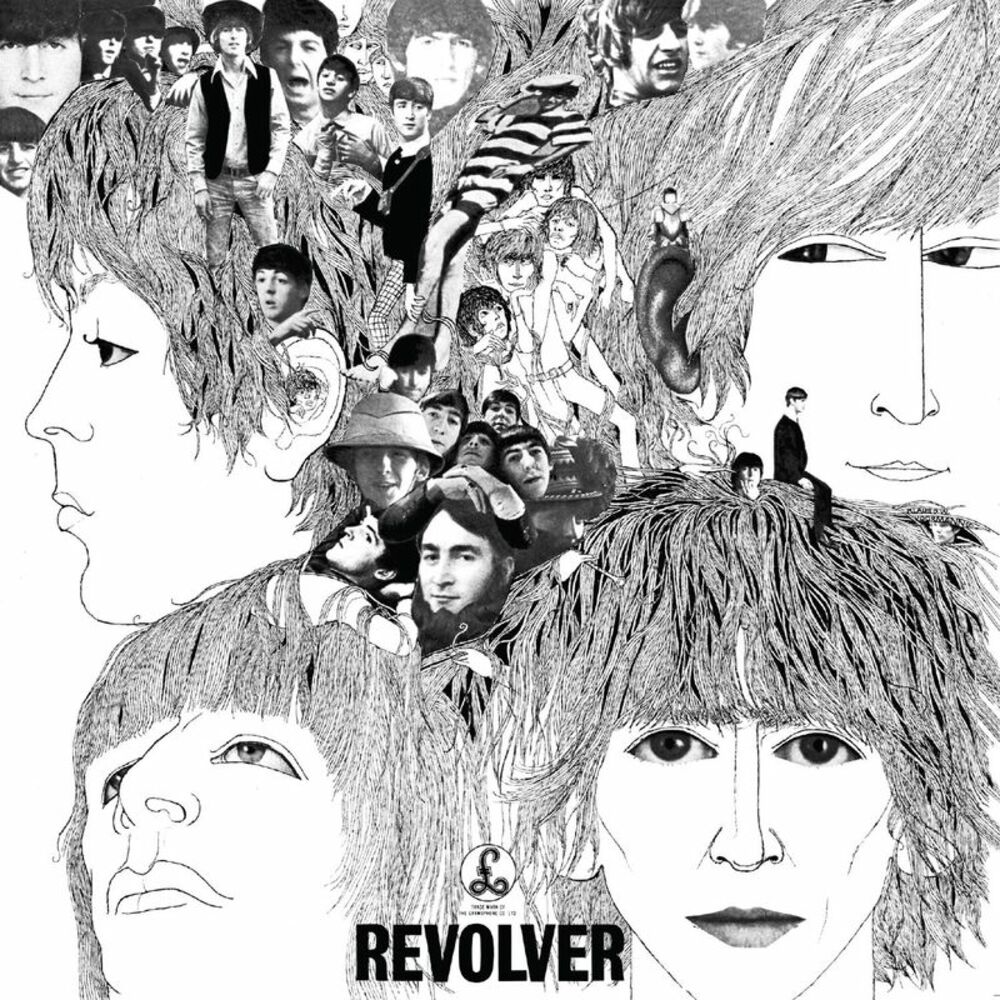
Revolver (Remastered 2009)
- Released24 December 2015
- UK peak No. 55
- Weeks on UK chart 2
- Entered UK chart 3 May 1987
- LabelEMI Catalogue
- Tracks14 · 34 min
3 tracks from it charted as singles. Press a flag to play it in the chart where it peaked.
Tracks
| 1 | Taxman (Remastered 2009) | 2:37 | |
| 2 | 2:04 | ||
| 3 | I'm Only Sleeping (Remastered 2009) | 2:59 | |
| 4 | Love You To (Remastered 2009) | 2:58 | |
| 5 | Here, There And Everywhere (Remastered 2009) | 2:23 | |
| 6 | 2:37 | ||
| 7 | She Said She Said (Remastered 2009) | 2:34 | |
| 8 | Good Day Sunshine (Remastered 2009) | 2:08 | |
| 9 | And Your Bird Can Sing (Remastered 2009) | 1:59 | |
| 10 | For No One (Remastered 2009) | 1:58 | |
| 11 | Doctor Robert (Remastered 2009) | 2:13 | |
| 12 | I Want To Tell You (Remastered 2009) | 2:26 | |
| 13 | Got To Get You Into My Life (Remastered 2009) No. 7 · 1976 | 2:27 | |
| 14 | Tomorrow Never Knows (Remastered 2009) | 2:59 |
About the album
Revolver is the seventh studio album by the English rock band the Beatles. It was released on 5 August 1966, accompanied by the double A-side single "Eleanor Rigby" and "Yellow Submarine". The album was the Beatles' final recording project before their retirement as live performers and marked the group's most overt use of studio technology to date, building on the advances of their late 1965 release Rubber Soul. It has since become regarded as one of the greatest and most innovative albums in the history of popular music, with recognition centred on its range of musical styles, diverse sounds and lyrical content.
The Beatles recorded Revolver after taking a three-month break at the start of 1966, and during a period when London was feted as the era's cultural capital. Regarded by some commentators as the start of the group's psychedelic period, the songs reflect their interest in the drug LSD, Eastern philosophy and the avant-garde while addressing themes such as death and transcendence of material concerns. With no plans to reproduce their new material in concert, the band made liberal use of automatic double tracking, varispeed, reversed tapes, close audio miking, and instruments outside of their standard live set-up.
Background
In December 1965, the Beatles' Rubber Soul album was released to wide critical acclaim. According to David Howard, the limits of pop music "had been raised into the stratosphere" by the release, resulting in a shift in focus away from singles to creating albums of consistently high quality. The following January, the Beatles carried out overdubs on live recordings taken from their 1965 US tour, for inclusion in the concert film The Beatles at Shea Stadium. The group's manager, Brian Epstein, had intended that 1966 would then follow the pattern of the previous two years, in terms of the band making a feature film and an accompanying album, followed by concert tours during the summer months. After the Beatles vetoed the proposed film project, the time allocated for filming became a further three months free of professional engagements. This was the longest period the band members had experienced outside the group collective since 1962, and it defied the convention that pop acts should be working almost continually.
Recording
The Beatles had hoped to work in a more modern facility than EMI's London studios at Abbey Road and were impressed with the sound on records created at Stax Studio in Memphis. In March 1966, Epstein investigated the possibility of their recording the new album at Stax, where, according to a letter written by Harrison two months later, the group intended to work with producer Jim Stewart. The idea was abandoned after locals began descending on the Stax building, as were alternative plans to use either Atlantic Studios in New York or Motown's Hitsville USA facility in Detroit.
Recording for the album instead began at EMI Studio 3 in London on 6 April, with George Martin again serving as producer. The first track attempted was Lennon's "Tomorrow Never Knows", the arrangement for which changed considerably between the initial take that day and the subsequent remake. This first version of "Tomorrow Never Knows", along with several other outtakes from the album sessions, was included on the 1996 compilation Anthology 2.
Artwork
The cover for Revolver was created by German-born bassist and artist Klaus Voormann, one of the Beatles' oldest friends from their time in Hamburg during the early 1960s. Voormann's artwork was part line drawing and part collage, using photographs mostly taken over 1964–65 by Robert Freeman. In his line drawings of the four Beatles (McCartney, Lennon, Harrison and Starr, clockwise from top-left), Voormann drew inspiration from the work of the nineteenth-century illustrator Aubrey Beardsley, who was the subject of a long-running exhibition at London's Victoria and Albert Museum in 1966 and highly influential on fashion and design themes of the time. Voormann placed the various photos within the tangle of hair that connects the four faces.
Title
The album's title, like that of Rubber Soul, is a pun, referring to both a kind of handgun and the "revolving" motion of a record as it plays on a turntable. Gould views the title as a "McLuhanesque pun", since, more so than on their previous albums, the focus of Revolver appears to rotate from one Beatle to another with each song.
The group had originally wanted to call the album Abracadabra, until they discovered that another band had already used it. When discussing possible alternatives, during their German tour, Lennon opted for Four Sides to the Circle in response to McCartney's Magic Circle, and Starr jokingly suggested After Geography, a play on the title of the Rolling Stones' recently released Aftermath LP. Other suggestions included Bubble and Squeak, Beatles on Safari, Freewheelin' Beatles and Pendulum before the band settled on Revolver. They confirmed their choice in a telegram to EMI, sent from the Tokyo Hilton on 2 July.
Release
In mid-May 1966, Tony Hall of Record Mirror wrote a preview of the Beatles' new recordings in which he opined that some of them were "the most revolutionary ever made by a pop group". While avoiding mention of the official song titles, he highlighted Lennon's "The Void" for its electronic effects, along with a "McCartney song about lonely people" set to string orchestration, and a "Harrison number on which he plays a long exotic solo on sitar". In Britain, EMI gradually distributed the album's songs to radio stations throughout July – a strategy that MacDonald describes as "building anticipation for what would clearly be a radical new phase in the group's recording career". Revolver was released there on 5 August and on 8 August in the United States. "Eleanor Rigby" was issued as a double A-side single with "Yellow Submarine".
Commercial performance
In the UK, where "Eleanor Rigby" was the favoured side, the single became the best-selling song of 1966, after topping the national chart for four weeks during August and September. On Record Retailer's LPs chart (later the UK Albums Chart), Revolver entered at number 1 and stayed there for seven weeks during its 34-week run in the top 40. On the national chart compiled by Melody Maker, the album was number 1 for nine weeks. By October, at least ten of the LP's songs had been covered by other artists and reviewed by Melody Maker. Among these, Cliff Bennett and the Rebel Rousers' version of "Got to Get You into My Life", which McCartney co-produced, was a top ten hit. McCartney's ballads "Here, There and Everywhere" and "For No One" became highly popular among mainstream recording artists. In the UK, Revolver was the second–highest-selling album of 1966, behind The Sound of Music.