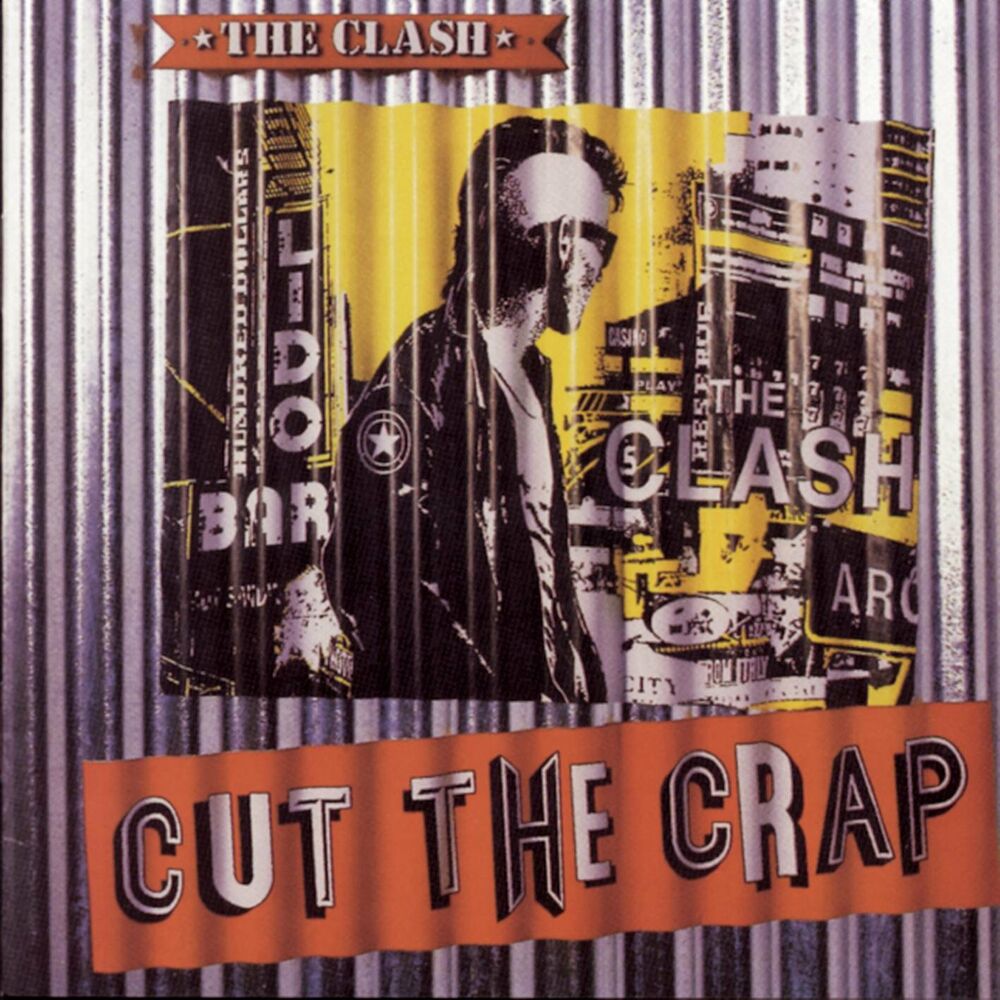
Cut The Crap
- Released4 November 1985
- UK peak No. 16
- Weeks on UK chart 3
- Entered UK chart 10 November 1985
- LabelEpic
- Tracks12 · 39 min
One track from it charted as a single. Press a flag to play it in the chart where it peaked.
Tracks
| 1 | Dictator | 3:00 | |
| 2 | Dirty Punk | 3:09 | |
| 3 | We are the Clash | 3:04 | |
| 4 | Are You Red..Y | 3:23 | |
| 5 | Cool under Heat | 3:13 | |
| 6 | Movers and Shakers | 3:03 | |
| 7 | This is England No. 24 · 1985 | 3:50 | |
| 8 | Three Card Trick | 3:10 | |
| 9 | Play to Win | 3:11 | |
| 10 | Fingerpoppin' | 3:15 | |
| 11 | North and South | 3:33 | |
| 12 | Life is Wild | 2:39 |
About the album
Cut the Crap! is the sixth and final studio album by the English punk band the Clash, released on 4 November 1985 by CBS Records. It was recorded in early 1985 at Weryton Studios, Munich, following a turbulent period: co-founder, lead guitarist and co-principal songwriter Mick Jones and drummer Topper Headon had been dismissed by lead vocalist Joe Strummer and bassist Paul Simonon (the latter of whom is nevertheless absent from the album). Jones and Headon were replaced by three unknowns: guitarists Vince White and Nick Sheppard and drummer Pete Howard. During the tense recording sessions, Clash manager Bernie Rhodes (who produced the album under the pseudonym "Jose Unidos") and Strummer fought each other for control over the band's songwriting and musical direction.
Strummer and Rhodes co-wrote most of the songs. During production, Rhodes took charge of the arrangements, track sequencing and the final mix. His production choices, which rely heavily on Strummer's preference for synthetic drum sounds and Rhodes's own inclusion of sampling, were widely derided. One writer described the album's sound as brash and seemingly "designed to sound hip and modern—'80s style!" Rhodes chose the album title, taken from a line in the 1981 post-apocalyptic film Mad Max 2. The recording process and tension between Rhodes and Strummer left other band members disillusioned.
Background
The Clash's internal difficulties during 1983 led to two of its core members being fired: guitarist Mick Jones was seen as adopting rock star posturing that lead vocalist Joe Strummer considered anathema to what the band stood for, and drummer Topper Headon had developed a heroin addiction which left him unreliable. After the band undertook rehearsals in London during June 1983, interpersonal tensions reemerged. The two principal songwriters no longer trusted each other, due to Jones's frequent absence from rehearsals and use of synthesizers. Both Jones and bassist Paul Simonon have said that they refused to sign the contract negotiated by manager Bernie Rhodes, who had earlier been fired due to personal differences with Jones.
The relationship between Strummer and Jones had broken down by this point. Not long into rehearsals, Strummer and Simonon had fired Jones. A week before the official announcement of the dismissal, Strummer, Simonon and Rhodes began to look for replacements and met Pete Howard.
Recording and production
The album was recorded between January and February 1985, on a 24-track mixing desk in Weryton Studios, Unterföhring, outside Munich, Germany, with some parts recorded in London. Epic Records chose the German studio because the band's finances were dependent on ongoing legal cases, including moves by Jones to prevent them recording under the name "the Clash". Rhodes hired engineer Micheal Fayne on the basis of affordability, and his prior experience with programmed drum machines, which Strummer wanted to use on the album because, according to Rhodes, "Joe wanted to compete with Mick's drum machine thing". Rhodes also employed engineers Ulrich A. Rudolf, Simon Sullivan and Kevin Whyte, who are credited on the sleeve.
Strummer and Rhodes disagreed on the direction of the recordings almost from the outset. Rhodes, credited on the sleeve under the pseudonym "Jose Unidos", had no previous experience with either songwriting or record production. While Strummer had been pleased with his demo versions, he fought against his manager over the album's production.
Music and lyrics
The consensus among critics is that the album's production choices distract from otherwise strong songwriting by Strummer and Rhodes. Strummer's vocals are placed low in the mix, sometimes buried underneath electronic drums, synthetic keyboards and studio effects. The sound has often been described as muddy and cluttered due to multi-layered guitar tracks and backing vocals. Many of the guitar overdubs have been considered unnecessary, given that Sheppard and White were both using Gibson Les Pauls and as such their sounds were tonally similar, and there was not significant variation in either their chord progressions or riffs. Rhodes may have felt the need to fill each channel on the 24-track mixing desk.
Critical reception
By the time the new "Mark II" line-up released Cut the Crap! on 4 November 1985, they were an accomplished live band, and had written and performed several songs that would appear on the final studio album; a few had been live favourites. On the strength of their recent gigs, the UK press were optimistically waiting for the album's release. Epic Records anticipated that both the three-year gap since Combat Rock (1982) along with their updated sound, would result in critical acclaim and high sales. In the promotional lead up, Strummer told journalist Richard Cook that he was not going to release any new material until he knew it could "last ten years". Most critics and fans were disappointed on its release—especially with its sound and production values, and the omission of stand-out live tracks "In the Pouring Rain" and "Ammunition", usually titled "Jericho" in contemporary bootleg recordings.
Cut the Crap! sold poorly compared to earlier Clash releases, reaching just number 16 in the UK charts and number 88 in the US.
Aftermath
Strummer was depressed by both the album's sound and critical appraisal. Asked in 1986 how the reviews affected him, he replied, "Sure I read [them] but I didn't need them to tell me. It was like when you're younger and you're trying to make a date with a girl but she won't have any of it. You keep going back, trying to fool yourself that this time will be better." He was particularly upset that people had thought the "Jose Unidos" pseudonym credited as a producer was him rather than Rhodes, and said "it wouldn't have been so bad if Bernie had just got the blame but that was unbearable." The album was cited by several contemporary reviewers as symptomatic of why punk rock had failed. Strummer said in 1988: "To someone who says I was ... 'the spokesman for your generation and you fucked it up', I say yeah, but we tried." He admitted that he had undertaken the project in part to prove that Jones had not been the Clash's only songwriter.
Epic Records intended a tour shortly after the release, but there were practical issues that made this impossible.