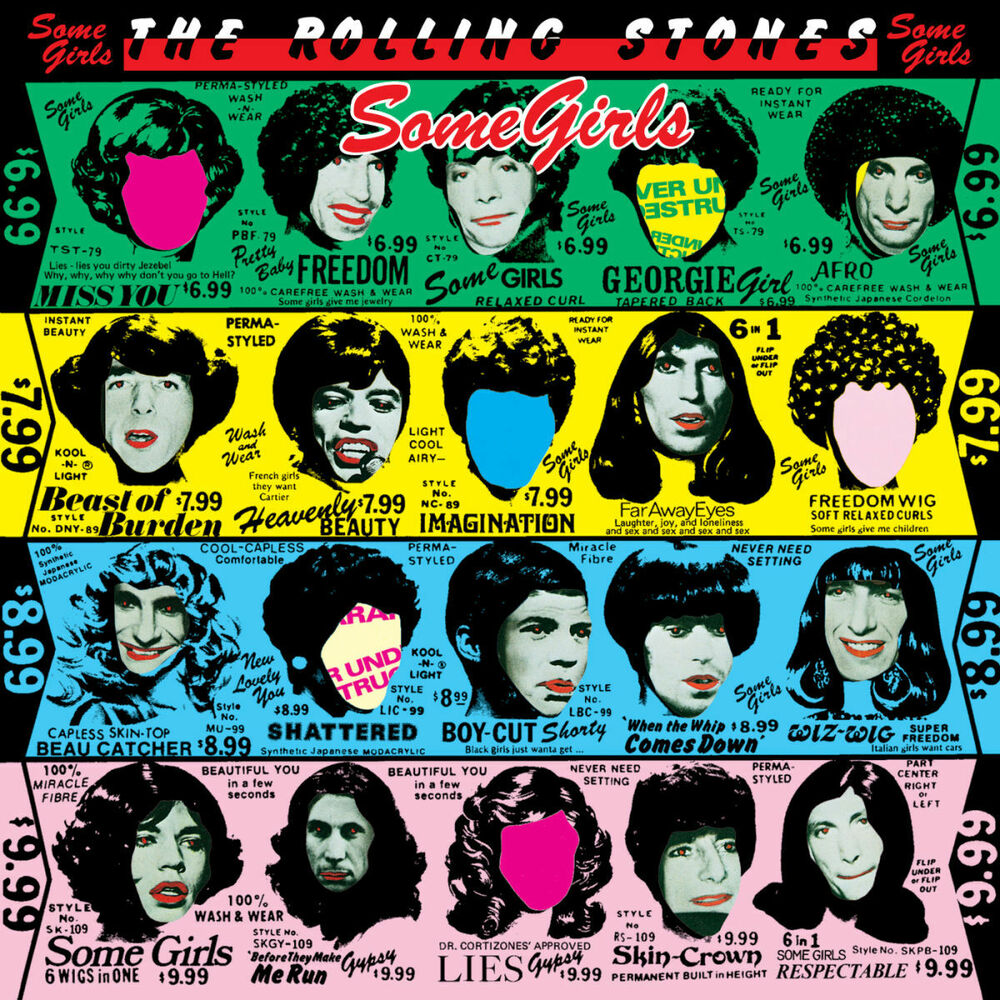
Some Girls
- Released21 November 2011
- UK peak No. 2
- Weeks on UK chart 25
- Entered UK chart 18 June 1978
- LabelPolydor Associated Labels
- Tracks10 · 41 min
4 tracks from it charted as singles. Press a flag to play it in the chart where it peaked.
Tracks
| 1 | 4:48 | ||
| 2 | When The Whip Comes Down (Remastered) | 4:20 | |
| 3 | Just My Imagination (Running Away With Me) (Remastered) | 4:38 | |
| 4 | Some Girls (Remastered) | 4:36 | |
| 5 | Lies (Remastered) | 3:11 | |
| 6 | Far Away Eyes (Remastered) | 4:24 | |
| 7 | Respectable (Remastered) No. 39 · 1978 | 3:06 | |
| 8 | Before They Make Me Run (Remastered) | 3:25 | |
| 9 | Beast Of Burden (Remastered 1994) No. 8 · 1978 | 4:25 | |
| 10 | Shattered (Remastered) No. 31 · 1979 | 3:47 |
About the album
Some Girls is the fourteenth studio album by the English rock band the Rolling Stones, released on 9 June 1978 by Rolling Stones Records. It was recorded in sessions held from October 1977 to February 1978 at Pathé Marconi Studios in Paris and produced by the band's chief songwriters – lead vocalist Mick Jagger and guitarist Keith Richards (credited as the Glimmer Twins) – with Chris Kimsey engineering the recording.
By 1976, the Rolling Stones' popularity was in decline as the music industry was dominated by disco and newer rock bands. In addition, the punk rock movement was an emerging cultural force in the UK. Due to legal troubles surrounding Richards, Jagger is generally regarded as the principal creative force behind Some Girls. With him drawing influence from dance music, most notably disco, the recording sessions were highly productive, resulting in numerous outtakes that appeared on subsequent albums.
It was the first album to feature guitarist Ronnie Wood as a full-time member; Wood had contributed to some tracks on the band's prior two albums, It's Only Rock 'n Roll (1974) and Black and Blue (1976). With a stable lineup in place for the first time in several years, the album marked a return to basics for the Rolling Stones and did not feature many guest musicians, unlike many of their prior albums.
Background
By 1976, the Rolling Stones' popularity was in decline as the charts were dominated by disco and newer bands such as Aerosmith and Kiss. In the UK, the punk rock movement was a rising force and made most artists connected with the 1960s era seem obsolete. The group had also failed to produce a critically acclaimed album since 1972's Exile on Main St.
On 7 February 1977, the Stones were scheduled to play El Mocambo in Toronto, Ontario; however, Keith Richards and his partner Anita Pallenberg were arrested for possession of heroin and suspected of drug trafficking. With the help of Jimmy Carter, who obtained visas, the pair was permitted to leave Canada so that Richards could undergo detoxification in the United States. During this time, Richards obtained a conditional visa for France and met the rest of the Stones in Paris to begin work on what became Some Girls. Facing the possibility of Richards receiving a seven-year sentence in Canada, Jagger and Richards both believed that the Stones might be forced to disband and that Some Girls could be the last album.
Writing and recording
Mick Jagger is generally regarded as the principal creative force behind Some Girls. Keith Richards was in legal trouble for much of 1977, which resulted in the band being inactive on the touring circuit during that year, except for two shows in Canada during the spring for the live album Love You Live. Jagger solely wrote "Miss You", as well as "Lies" and "When the Whip Comes Down". In addition to punk, Jagger claims to have been influenced by dance music, most notably disco, during the recording of Some Girls, and cites New York City as a major inspiration for the album, an explanation for his lyrical preoccupation with the city throughout.
At least as important for the band's reinvigoration was the addition of Ronnie Wood to the lineup, as Some Girls was the first album recorded with him as a full member. Unlike the guitar style of Mick Taylor, Wood's guitar playing style meshed with that of Richards, and slide guitar playing became one of the band's hallmarks. His unconventional uses of the instrument featured prominently on Some Girls and he contributed to the writing process.
Packaging and artwork
The album cover for Some Girls was a collaborative effort involving the design by Peter Corriston and illustrations by Hubert Kretzschmar. Kretzschmar recalled the album originally had the working title "Lies". The two would design the band's next three album covers. An elaborate die-cut design, with the colours on the sleeves varying in different markets, it featured the Rolling Stones' faces alongside those of select female celebrities inserted into a copy of an old Valmor Products Corporation advertisement. The first printing of the album was censored as The Rolling Stone lawyers could not get permission to use those actors' images. The cover design was challenged legally when Lucille Ball, Farrah Fawcett, Liza Minnelli (representing her mother Judy Garland), Raquel Welch, and the estate of Marilyn Monroe threatened to sue for the use of their likenesses without permission.
Marketing and sales
The lead single, "Miss You", was released on 19 May 1978 by the band's own Rolling Stones label, with the album track "Far Away Eyes" as the B-side; a longer, 12" edit appeared on 2 June. The single was a commercial success, spending seven weeks on the UK Singles Chart, eventually peaking at number three. It fared better in the US, spending 20 weeks on the Billboard Hot 100 – longer than any prior Rolling Stones single – eventually peaking at number one, the band's final single to top the chart. Despite its commercial success, its disco sound alienated part of the fanbase. Regarding this, Jagger stated:
There were a lot of people that were very narrow-minded about it. To me, I wasn't brought up on rock music so much as blues and soul music, and lot of that music was dance music. It was specifically made to dance to... You don't really play the grooves of yesteryear when you make records, you play the grooves of now. And that sort of beat was the thing that was going around at the time.
Critical reception and legacy
Upon release, Some Girls received extremely positive reviews from music critics, with many agreeing it was the Stones' best work since Exile on Main St. Music critic Pete Bishop wrote for The Pittsburgh Press that Some Girls was "the best album the Rolling Stones have done for years". Robert Hilburn ranked Some Girls one of the band's best works in the Los Angeles Times, calling it a "splendid return to form". Reviewing for The Village Voice in 1978, Robert Christgau said,The Stones' best album since Exile on Main St. is also their easiest since Let It Bleed or before. They haven't gone for a knockdown uptempo classic, a 'Brown Sugar' or 'Jumpin' Jack Flash'—just straight rock and roll unencumbered by horn sections or Billy Preston. Even Jagger takes a relatively direct approach, and if he retains any credibility for you after six years of dicking around, there should be no agonizing over whether you like this record, no waiting for tunes to kick in.