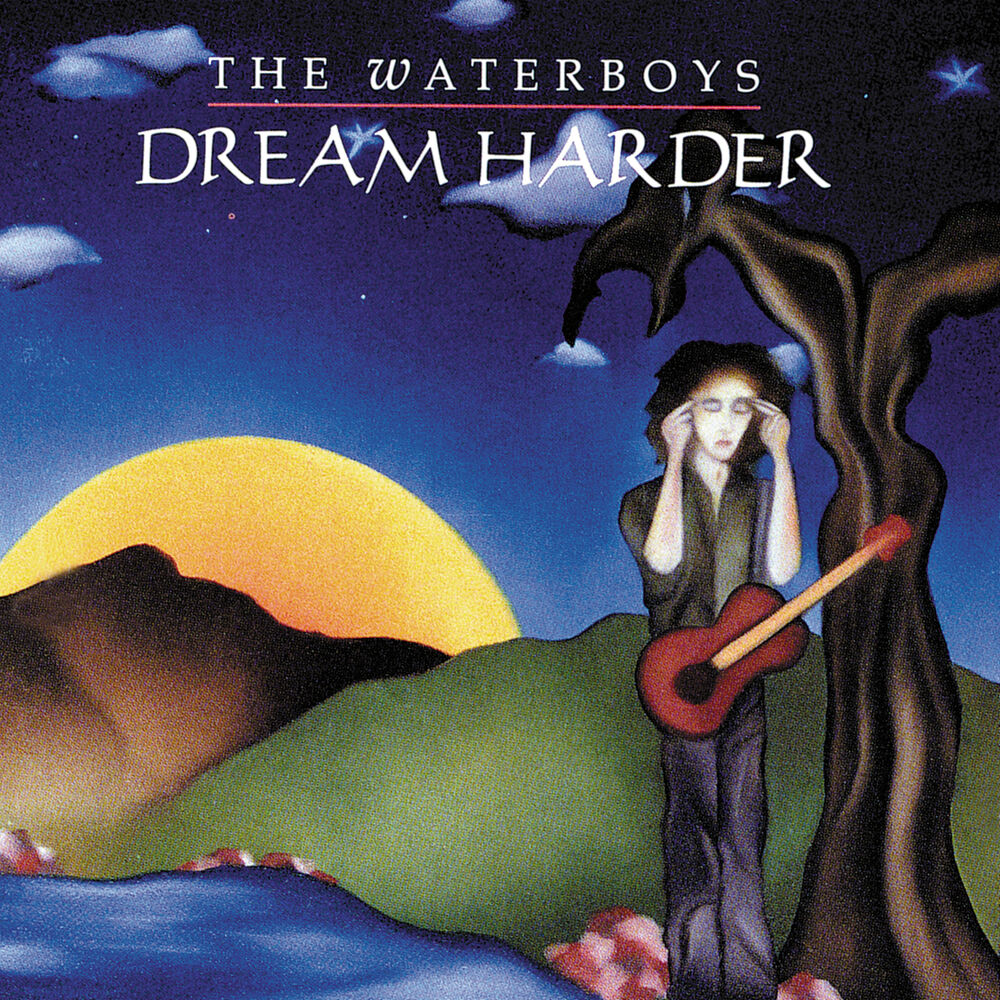
Dream Harder
- Released25 May 1993
- UK peak No. 5
- Weeks on UK chart 10
- Entered UK chart 30 May 1993
- LabelGeffen
- Tracks12 · 43 min
2 tracks from it charted as singles. Press a flag to play it in the chart where it peaked.
Tracks
| 1 | The New Life | 5:08 | |
| 2 | Glastonbury Song No. 29 · 1993 | 3:42 | |
| 3 | Preparing To Fly | 4:34 | |
| 4 | The Return Of Pan No. 24 · 1993 | 4:19 | |
| 5 | Corn Circles | 4:05 | |
| 6 | Suffer | 3:49 | |
| 7 | Winter Winter | 0:33 | |
| 8 | Love And Death | 2:44 | |
| 9 | Spiritual City | 3:07 | |
| 10 | Wonders Of Lewis | 2:04 | |
| 11 | The Return Of Jimi Hendrix | 5:48 | |
| 12 | Good News | 3:35 |
About the album
Dream Harder is the sixth studio album by the Waterboys, released by Geffen Records on 24 May 1993. Led by Scottish singer-songwriter-instrumentalist Mike Scott, the album features none of the earlier UK-based band members and instead finds Scott backed by American session musicians. It was the last Waterboys album before Scott spent seven years pursuing a formal solo career, with Bring 'Em All In (1995) and Still Burning (1997). The album reached position 171 on the Billboard Top 200 charts, surpassing the previous Waterboys album Room to Roam, in spite of a less-than-enthusiastic response from critics to the album's sound.
The album art was provided by the photography of Michael Halsband and John Hardin and the painting of Pal Shazar, under the direction of Frank Olinsky and Tom Zutaut.
Dream Harder was a return to a rock, or even hard rock, sound after the traditional Celtic-influenced preceding two albums. It did, however, continue the Waterboys' tradition of arranging a William Butler Yeats poem, in this case "Love And Death". "The Return of Pan" is the Waterboys' second ode to the Greek deity, and the album contains a number of references to the romantic Neopaganism of Dion Fortune and the mystical Christianity of C. S. Lewis, as well as a tribute to guitarist Jimi Hendrix.
Background
Shortly before the release of the Waterboys' fifth studio album, Room to Roam, Mike Scott and his long-time band member Anthony Thistlethwaite decided they wanted to change the band's musical direction by returning to their rock-orientated sound. As a result, the "Magnificent Seven" line-up parted ways before the album's tour and a new four-piece version of the band toured with a rock-dominated sound. Scott then looked for fresh inspiration by relocating from Ireland to Greenwich Village, New York, in September 1991. While most of the songs which appeared on Dream Harder were written when Scott was still living in Ireland, work on recording the album did not begin until January 1992, after Scott had signed a new record deal with Geffen Records. The label's A&R man suggested that Scott collaborate with producer Bill Price and they produced Dream Harder together. Scott told Melody Maker in 1993, "Geffen knew I wanted to do a gung-ho rock 'n' roll album and they suggested him.
Critical reception
Upon its release, Mat Smith of Melody Maker praised "Dream Harder" as a "truly monumental return to form" and a "psyche-altering explosion of spiritual fireworks". As a return to the band's original rock-based sound, Smith described it as "the album Waterboys fans have waited nearly eight years for" and noted that the guitars, "electric at last!", "scream like a resurrectional choir beckoning [Scott] back through the paradisal gates". At the end of the year, Melody Maker placed the album at number 38 on their top 40 "albums of the year" list. Neil Spencer of The Observer considered the album to have a sound "dominated by fretboard-throttling rock guitar". He added, "While more appealing to a US audience, the new sound sits oddly with Scott's pagan concerns, but Scott's enthusiasm for thundering tunes and offbeat themes is infectious."
Robin Denselow of The Guardian felt that despite its "New Yorkised production sheen", the album is "still Scott-as-hippie-gypsy", with most of the songs having a "starchild vein" and a "run-reading ambience".