2 tracks from it charted as singles. Press a flag to play it in the chart where it peaked.
Tracks
| 1 | 5D (Fifth Dimension) | 2:33 | |
| 2 | Wild Mountain Thyme | 2:30 | |
| 3 | Mr. Spaceman No. 36 · 1966 | 2:09 | |
| 4 | I See You | 2:38 | |
| 5 | What's Happening? | 2:35 | |
| 6 | I Come and Stand at Every Door | 3:03 | |
| 7 | 3:34 | ||
| 8 | Hey Joe (Where You Gonna Go) | 2:17 | |
| 9 | Captain Soul | 2:53 | |
| 10 | John Riley | 2:57 | |
| 11 | 2-4-2 Fox Trot (The Lear Jet Song) | 2:12 | |
| 12 | Why (Single Version) | 2:58 | |
| 13 | I Know My Rider (I Know You Rider) | 2:43 | |
| 14 | Psychodrama City | 3:23 | |
| 15 | 3:19 | ||
| 16 | Why (Alternate/RCA Studios Version) | 2:40 | |
| 17 | John Riley (instrumental version 1) | 16:53 |
About the album
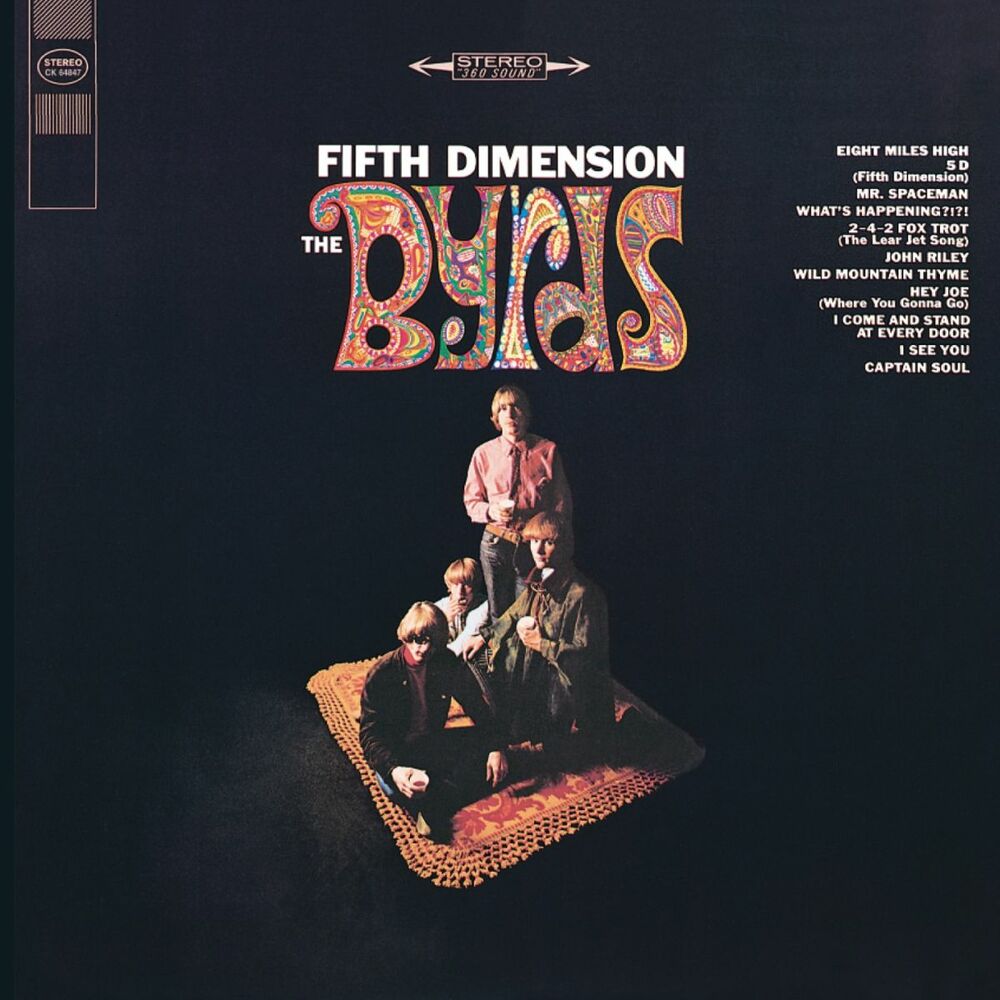
Fifth Dimension is the third studio album by the American rock band the Byrds, released on July 18, 1966, by Columbia Records. Most of the album was recorded following the February 1966 departure of the band's principal songwriter Gene Clark. In an attempt to compensate for Clark's absence, guitarists Jim McGuinn and David Crosby increased their songwriting output. In spite of this, the loss of Clark resulted in an album with four cover versions and an instrumental, which critics have described as "wildly uneven" and "awkward and scattered". However, it was the first Byrds album not to include any songs written by Bob Dylan, whose material had previously been a mainstay of the band's repertoire.
The album peaked at number 24 on the Billboard Top LPs chart and reached number 27 on the UK Albums Chart. Two preceding singles, "Eight Miles High" and "5D (Fifth Dimension)", were included on the album, with the former just missing the Top 10 of the Billboard singles chart. Additionally, a third single taken from the album, "Mr. Spaceman", managed to reach the U.S. Top 40. Upon release, Fifth Dimension was widely regarded as the band's most experimental album to date and is today considered by critics to be influential in originating the musical genre of psychedelic rock.
Background
On December 22, 1965, shortly after the release of their second album Turn! Turn! Turn!, the Byrds entered RCA Studios in Los Angeles to record "Eight Miles High" and "Why", two new songs that they had recently composed. Both songs represented a creative leap forward for the band and were instrumental in developing the musical styles of psychedelic rock and raga rock. However, the band ran into trouble with their record company, Columbia Records, who refused to release either song because they had not been recorded at a Columbia-owned studio. As a result, the band were forced to re-record both songs in their entirety at Columbia Studios, Hollywood, and it was these re-recordings that would see release on the "Eight Miles High" single and the Fifth Dimension album.
The re-recordings of "Eight Miles High" and "Why" were produced by Allen Stanton, Columbia's West Coast Vice President, who had recently been assigned to the band following the Byrds' decision to dispense with their previous producer, Terry Melcher.
Music
The best known song on the album is the hit single "Eight Miles High", an early excursion into psychedelic rock. Musically, the song was a fusion of John Coltrane-influenced guitar playing—courtesy of lead guitarist Jim McGuinn—and raga-based musical structure and vocals, inspired by the Indian classical music of Ravi Shankar. Written mostly by Clark in November 1965, while the Byrds were on tour in the U.S., the song was pivotal in transmuting folk rock into the new musical forms of psychedelia and raga rock. Regardless of its innovative qualities, however, many radio stations in the U.S. banned the record, believing the title to be a reference to recreational drug use. Although the song's lyrics actually pertained to the approximate cruising altitude of commercial airliners, and the group's first visit to London during their 1965 English tour, both Clark and rhythm guitarist David Crosby later admitted that the song was at least partly inspired by their own drug use.
The album also included the McGuinn-penned songs "5D (Fifth Dimension)" and "Mr.
Release and legacy
Fifth Dimension was released on July 18, 1966 in the United States (catalogue item CL 2549 in mono, CS 9349 in stereo) and September 22, 1966 in the UK (catalogue item BPG 62783 in mono, SBPG 62783 in stereo). It peaked at number 24 on the Billboard Top LPs chart, during a chart stay of 28 weeks, and reached number 27 in the United Kingdom. The album's front cover featured a photograph taken by the graphic design company Horn/Griner and also featured the first appearance of the Byrds' colorful psychedelic mosaic logo.
The preceding "Eight Miles High" single was released on March 14, 1966 in the U.S., and April 29, 1966 in the UK, reaching number 14 on the Billboard Hot 100 and number 24 on the UK Singles Chart. A second single, "5D (Fifth Dimension)", was released on June 13, 1966 in America and July 29, 1966 in the UK, peaking at number 44 on the Billboard Hot 100, but failing to chart in the UK. A third single taken from the album, "Mr. Spaceman", was issued on September 6, 1966 and reached number 36 on the Billboard Hot 100, but it too failed to chart in the UK.