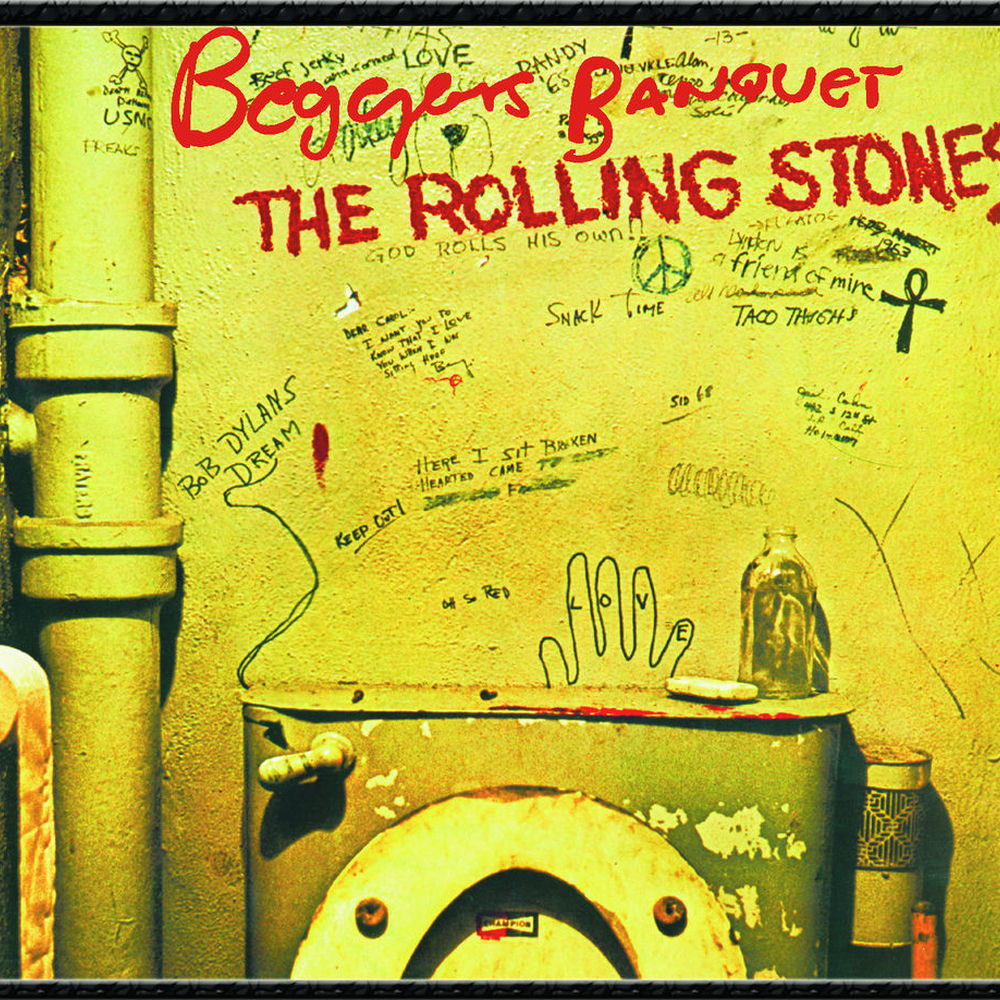
Beggars Banquet
- Released16 November 2018
- UK peak No. 3
- Weeks on UK chart 12
- Entered UK chart 15 December 1968
- LabelABKCO Music and Records, Inc.
- Tracks10 · 40 min
2 tracks from it charted as singles. Press a flag to play it in the chart where it peaked.
Tracks
| 1 | 6:17 | ||
| 2 | No Expectations | 3:56 | |
| 3 | Dear Doctor | 3:22 | |
| 4 | Parachute Woman | 2:20 | |
| 5 | Jigsaw Puzzle | 6:05 | |
| 6 | 3:15 | ||
| 7 | Prodigal Son | 2:51 | |
| 8 | Stray Cat Blues | 4:37 | |
| 9 | Factory Girl | 2:08 | |
| 10 | Salt Of The Earth | 4:48 |
About the album
Beggars Banquet is the seventh studio album by the English rock band the Rolling Stones, released on 6 December 1968 by Decca Records in the United Kingdom and London Records in the United States. It was their first album produced by Jimmy Miller, whose production work formed a key aspect of the Rolling Stones' sound throughout the late 1960s and early 1970s.
Brian Jones, the band's co-founder and early leader, had become increasingly unreliable in the studio due to his drug use, and it was the last Rolling Stones album to be released during his lifetime, though he also contributed to two songs on their next album Let It Bleed, which was released after his death (Jones also contributed to the group's hit song "Jumpin' Jack Flash", which was part of the same sessions, and released in May 1968). Nearly all rhythm and lead guitar parts were recorded by Keith Richards, the Rolling Stones' other guitarist and the primary songwriting partner of their lead singer Mick Jagger; together the two wrote all but one of the tracks on the album. Rounding out the instrumentation were bassist Bill Wyman and drummer Charlie Watts, though all members contributed on a variety of instruments.
Recording and production
Glyn Johns, the album's recording engineer and a longtime collaborator of the band, said that Beggars Banquet signalled "the Rolling Stones' coming of age. ... I think that the material was far better than anything they'd ever done before. The whole mood of the record was far stronger to me musically." Producer Jimmy Miller described guitarist Keith Richards as "a real workhorse" while recording the album, mostly due to the infrequent presence of Brian Jones. When he did show up at the sessions, Jones behaved erratically due to his drug use and emotional problems. Miller said that Jones would "show up occasionally when he was in the mood to play, and he could never really be relied on:
When he would show up at a session—let's say he had just bought a sitar that day, he'd feel like playing it, so he'd look in his calendar to see if the Stones were in. Now he may have missed the previous four sessions. We'd be doing let's say, a blues thing. He'd walk in with a sitar, which was totally irrelevant to what we were doing, and want to play it. I used to try to accommodate him.
Packaging
According to Keith Richards, the album's title was thought up by British art dealer Christopher Gibbs. The album's original front and back cover art, photographs by Barry Feinstein depicting a bathroom wall covered with graffiti, was rejected by the band's record company, which delayed the album's release for months. Feinstein's photographs were later featured though on most vinyl, compact disc and cassette tape reissues of the album. On 7 June 1968, a photoshoot for the album's gatefold, with photographer Michael Joseph, was held at Sarum Chase, a mansion in Hampstead, London. Previously unseen images from the shoot were exhibited at the Blink Gallery in London in November and December 2008.
Release and promotion
Beggars Banquet was first released in the United Kingdom by Decca Records on 6 December 1968, and in the United States by London Records the following day. Like the band's previous album, it reached number three on the UK Albums Chart, but remained on the chart for fewer weeks. The album peaked at number five on the Billboard 200.
On 11–12 December 1968 the band filmed a television extravaganza titled The Rolling Stones Rock and Roll Circus featuring John Lennon, Eric Clapton, the Who, Jethro Tull and Marianne Faithfull among the musical guests. One of the original aims of the project was to promote Beggars Banquet, but the film was shelved by the Rolling Stones until 1996, when their former manager, Allen Klein, gave it an official release.
Critical reception
Beggars Banquet received a highly favourable response from music critics, who considered it a return to form for the Stones. Author Stephen Davis writes of its impact: "[The album was] a sharp reflection of the convulsive psychic currents coursing through the Western world. Nothing else captured the youthful spirit of Europe in 1968 like Beggars Banquet."
According to music journalist Anthony DeCurtis, the "political correctness" of "Street Fighting Man", particularly the lyrics "What can a poor boy do/'Cept sing in a rock and roll band", sparked intense debate in the underground media.
Reissues
In August 2002, ABKCO Records reissued Beggars Banquet as a newly remastered LP and SACD/CD hybrid disk. This release corrected a flaw in the original album by restoring each song to its proper, slightly faster speed. Due to an error in the mastering, Beggars Banquet was heard for over thirty years at a slower speed than it was recorded. This had the effect of altering not only the tempo of each song, but the song's key as well. These differences were subtle but important, and the remastered version is about 30 seconds shorter than the original release.