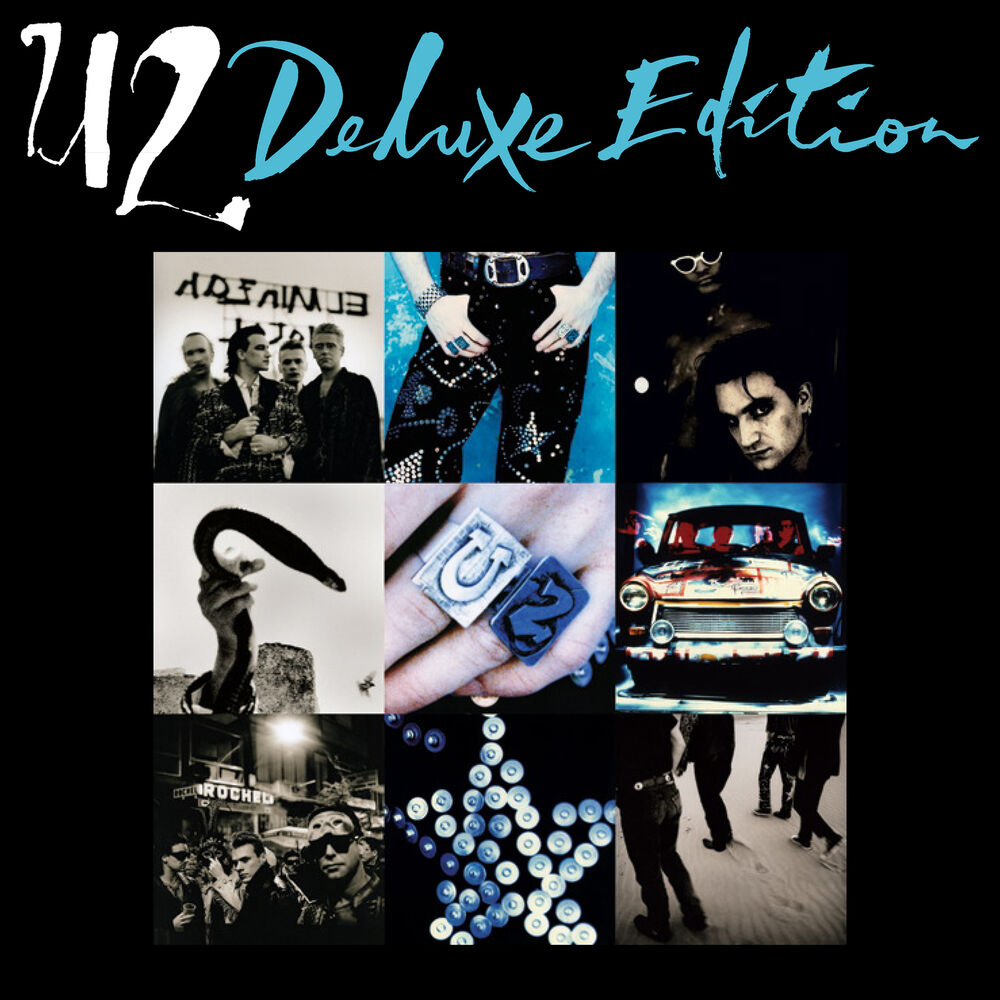
Achtung Baby (Deluxe Edition)
- Released1 January 2011
- UK peak No. 2
- Weeks on UK chart 93
- Entered UK chart 24 November 1991
- LabelUniversal-Island Records Ltd.
- Tracks25 · 114 min
5 tracks from it charted as singles. Press a flag to play it in the chart where it peaked.
Tracks
| 1 | Zoo Station | 4:36 | |
| 2 | 3:41 | ||
| 3 | 4:36 | ||
| 4 | Until The End Of The World | 4:39 | |
| 5 | 5:16 | ||
| 6 | So Cruel | 5:49 | |
| 7 | 4:29 | ||
| 8 | 4:04 | ||
| 9 | Tryin' To Throw Your Arms Around The World | 3:53 | |
| 10 | Ultra Violet (Light My Way) | 5:31 | |
| 11 | Acrobat | 4:30 | |
| 12 | Love Is Blindness | 4:23 | |
| 13 | Lady With The Spinning Head (UV1) | 3:53 | |
| 14 | Blow Your House Down | 3:30 | |
| 15 | Salomé | 4:35 | |
| 16 | 3:41 | ||
| 17 | Satellite Of Love | 4:00 | |
| 18 | 4:48 | ||
| 19 | Paint It Black | 3:20 | |
| 20 | 4:09 | ||
| 21 | 7:05 | ||
| 22 | Night And Day (Steel String Remix) | 6:57 | |
| 23 | The Lounge Fly Mix | 6:30 | |
| 24 | Fortunate Son | 2:43 | |
| 25 | Alex Descends Into Hell For A Bottle Of Milk / Korova 1 | 3:39 |
About the album
Achtung Baby ( AHKH-toong) is the seventh studio album by the Irish rock band U2. It was produced by Daniel Lanois and Brian Eno, and was released on 18 November 1991 by Island Records. After criticism of their 1988 documentary film and album Rattle and Hum and a sense of creative stagnation, U2 shifted their direction to incorporate influences from alternative, industrial, and electronic dance music into their sound. Thematically, Achtung Baby is darker, more introspective, and at times more flippant than their previous work. For his lyrics, lead vocalist Bono was partly inspired by the failed marriages of two friends, including U2's guitarist the Edge.
Seeking inspiration from German reunification, U2 began recording Achtung Baby at Berlin's Hansa Studios in October 1990. The sessions were fraught with conflict, as the band argued over their musical direction and the quality of their material. After tension and slow progress nearly prompted the group to disband, they made a breakthrough with the improvised writing of the song "One". Morale and productivity improved during subsequent recording sessions in Dublin, where the album was completed in 1991.
Background
After U2's 1987 album The Joshua Tree and the supporting Joshua Tree Tour brought them critical acclaim and commercial success, their 1988 double album and documentary film Rattle and Hum precipitated a critical backlash. Although the record sold 14 million copies and performed well on music charts, critics were dismissive of it and the film, labelling the band's exploration of early American music as "pretentious" and "misguided and bombastic". U2's high exposure and their reputation for being overly serious led to accusations of grandiosity and self-righteousness.
Despite their commercial popularity, the group were dissatisfied creatively; lead vocalist Bono believed they were musically unprepared for their success, while drummer Larry Mullen, Jr. said, "We were the biggest, but we weren't the best." By the band's 1989 Lovetown Tour, they had become bored with playing their greatest hits. U2 believed that audiences misunderstood the group's collaboration with blues musician B. B.
Recording and production
U2 hired Daniel Lanois and Brian Eno to produce the album, based on the duo's prior work with the band on The Unforgettable Fire and The Joshua Tree. Lanois was principal producer, with Mark "Flood" Ellis as engineer. Eno took on an assisting role, working with the group in the studio for a week at a time to review their songs before leaving for a month or two. Eno said his role was "to come in and erase anything that sounded too much like U2". By distancing himself from the work, he believed he provided the band with a fresh perspective on their material each time he rejoined them. As he explained, "I would deliberately not listen to the stuff in between visits, so I could go in cold". Since U2 wanted the record to be harder-hitting and live-sounding, Lanois "push[ed] the performance aspect very hard, often to the point of recklessness". The Lanois–Eno team used lateral thinking and a philosophical approach—popularised by Eno's Oblique Strategies—that contrasted with the direct and retro style of Rattle and Hum producer Jimmy Iovine.
Music
U2 is credited with composing the music for all of Achtung Baby's tracks, despite periods of separated songwriting. They wrote the music primarily through jam sessions, a common practice for them. The album represents a deviation from the sound of their past work; the songs are less anthemic in nature, and their musical style demonstrates a more European aesthetic, introducing influences from alternative rock, industrial music, and electronic dance music. The band referred to the album's musical departure as "the sound of four men chopping down The Joshua Tree". Accordingly, the distorted introduction to the opening track "Zoo Station" was intended to make listeners think the record was broken or was mistakenly not the new U2 album.
Lyrics
As is often the case on U2 albums, Bono is credited as the sole lyricist. In contrast to U2's previous records, whose lyrics were politically and socially charged, Achtung Baby is more personal and introspective, examining love, sexuality, spirituality, faith, and betrayal. The lyrics are darker in tone, describing troubled personal relationships and exuding feelings of confusion, loneliness, and inadequacy. Lyrics were inspired by the dissolution of the Edge's marriage, as well as that of another of Bono's friends. During the album's recording, the Edge separated from his wife (the mother of three of his children), and the pain he felt resulted in him dedicating himself to the record and advocating for more personal themes. Bono found inspiration from his own personal life, citing the births of his two daughters in 1989 and 1991 as major influences. This is reflected in "Zoo Station", which opens the album as a statement of intent with lyrics suggesting new anticipations and appetites.
Of the album's personal nature, Bono said that there were a lot of "blood and guts" in it.
Packaging and title
The sleeve artwork for Achtung Baby was designed by two employees from the design firm Works Associates: Steve Averill, U2's long-time album cover designer; and Shaughn McGrath, who had just joined the firm. To parallel the band's change in musical direction, Averill and McGrath devised sleeve concepts that used multiple colour images to contrast with the seriousness of the individual, mostly monochromatic images from previous U2 album sleeves. Rough sketches and designs were created early during the recording sessions, and some experimental designs were conceived to closely resemble dance music sleeves. Averill said: "We just did them to show how extreme we could go and then everyone came back to levels that they were happy with. But if we hadn't gone to these extremes it may not have been the cover it is now."
An initial photo shoot with the band's long-time photographer Anton Corbijn was conducted near U2's Berlin hotel in late 1990. Most of the photos were black-and-white, and the group felt they were not indicative of the spirit of the new album.