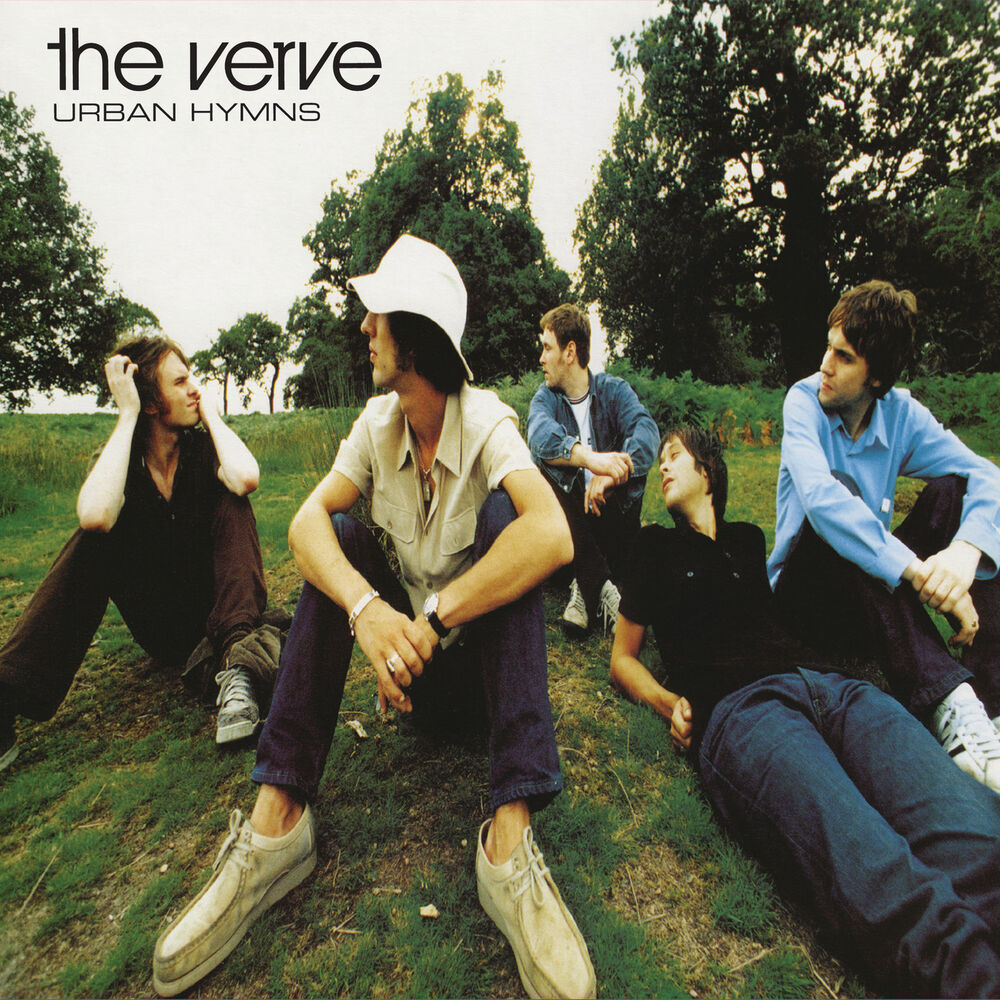
Urban Hymns (Remastered 2016)
- Released1 September 2017
- UK peak No. 1
- Weeks on UK chart 162
- Entered UK chart 5 October 1997
- LabelUMC (Universal Music Catalogue)
- Tracks13 · 76 min
4 tracks from it charted as singles. Press a flag to play it in the chart where it peaked.
Tracks
| 1 | 5:57 | ||
| 2 | Sonnet No. 74 · 1998 | 4:22 | |
| 3 | The Rolling People | 7:02 | |
| 4 | The Drugs Don't Work No. 1 · 1997 | 5:05 | |
| 5 | Catching The Butterfly | 6:26 | |
| 6 | Neon Wilderness | 2:38 | |
| 7 | Space And Time | 5:37 | |
| 8 | Weeping Willow | 4:50 | |
| 9 | Lucky Man No. 7 · 1997 | 4:53 | |
| 10 | One Day | 5:03 | |
| 11 | This Time | 3:51 | |
| 12 | Velvet Morning | 4:57 | |
| 13 | Come On / Deep Freeze (Hidden Track) | 15:15 |
About the album
Urban Hymns is the third studio album by English rock band the Verve, released on 29 September 1997 on Hut Records. The group had broken up while promoting A Northern Soul in August 1995, though they reformed two weeks later without guitarist Nick McCabe. Frontman Richard Ashcroft moved to Bath, Somerset, where he made demos; Simon Tong joined the group soon afterwards. Following aborted recording sessions with producers John Leckie and Owen Morris, the band sought a new guitarist, contacting former Suede guitarist Bernard Butler, who played with them for a week before departing amidst creative differences. In 1996, the Verve started recording at Olympic Studios in London, first with producer Martin "Youth" Glover, followed by engineer Chris Potter. Ashcroft contacted McCabe in early 1997, inviting him back into the band, which McCabe accepted. Several songs were re-recorded to allow for the inclusion of McCabe's guitar parts, with sessions continuing into May 1997.
"Bitter Sweet Symphony" was released as the lead single from Urban Hymns in June 1997; the track suffered from a debate over its writing credits due to its use of a sample of the Rolling Stones. "The Drugs Don't Work" followed as the second single from the album in September 1997, which was promoted with three supporting dates for Oasis in London.
Background
The Verve released their second studio album, A Northern Soul, in July 1995 through Hut Records, peaking at number 13 in the UK Albums Chart. Its three singles – "This Is Music", "On Your Own", and "History" – all charted within the top 40 of the UK Singles Chart, with "History" reaching the highest at number 24. In the lead-up to the album, the culture of the 1990s had shifted with the emergence of new lad and Loaded magazine, as well as the continual evolution of football culture and Britpop becoming a mainstream movement. Initial promotion consisted of a one-off show in Newcastle, a supporting slot for Oasis in Scotland, a performance at Phoenix Festival, and a US tour. The strained relationships between the band members came to a head when they performed at T in the Park in August 1995; at its conclusion, frontman Richard Ashcroft announced his departure from the band.
Music
The music of Urban Hymns has been described as Britpop, indie rock, orchestral rock, psychedelic, and post-Britpop, in the vein of Big Star and Oasis. Author Velimir Ilic noted in his book The Verve: Mad Urban Soul (1997) that mid-tempo compositions that owed their debts to Roxy Music, alongside giving it references, points to the likes of Astral Weeks (1968) by Van Morrison, The Wall (1979) by Pink Floyd, and Exile on Main St. (1972) by the Rolling Stones. Max Pilley of Drowned in Sound commented that with McCabe and Potter working on the album, the work of Amon Düül II and Spacemen 3 acted as influences in its creation. Ashcroft's vocals have been compared to those of U2 frontman Bono during the October (1981) era. A Northern Soul's string-laden ballad "History" acted as a prototype for the material on Urban Hymns. On the latter album, the songs did not feature the typical publishing credit attributed to all of the band members.
Lyrics and themes
Journalist Neil Strauss, writing for The New York Times, summarised Urban Hymns as tackling depression while smiling; appreciating the dark days in life as a positive day was probably to follow it. With the album's lyrics, Ashcroft became more open, as he reached a point where he no longer felt that he had to hide behind unnecessary imagery in his words. He intentionally altered his lyrical style for Urban Hymns. Egan said the lyrical transformation of leaving behind such allusions that had started with A Northern Soul was completed by Urban Hymns. Ashcroft commented that the most difficult thing for him to comprehend lately was that it was difficult to fully know a person and for a person to fully know him: "When you grow up you learn to belong by covering yourself up.
Artwork and packaging
To usher in this new period for the Verve, designer Brian Cannon set about to make a template for the band's releases. Egan said the previous way of making elaborate set pieces was ditched. For the album, Ashcroft told Cannon that he did not want anything too complex for the artwork, wanting the music to speak for itself. The cover photo was a group shot that Egan said was peculiar, as the members did not want to intentionally pose for it. To compromise, the band, Cannon, and photographer Michael Spencer Jones visited Richmond Park in London solely to see what a photography session might result in. Another photographer was present to also take some images, which made Jones feel awkward. The Verve was sitting on the grass as they were waiting for a lighting set-up to be finished when they witnessed a deer herd roaming around the park.
When Jones observed that the members of the Verve had relaxed, he decided to take an image, though none of the band were aware at the session. The subsequent photograph shows nearly all of the members, bar McCabe, facing left.
Reception
Urban Hymns received widespread critical praise upon its release. Many critics latched on to Ashcroft's role, in particular his voice. Tom Lanham of Entertainment Weekly wrote that Ashcroft conveys his voice "like churchworthy gospel. Or at least a tidy sermon for jaded MTVers." Los Angeles Times writer Sara Scribner found Ashcroft to be oddly "detached yet brimming over with pathos all at once." McCormick mentioned that Ashcroft had a knack for detailing his "despair without self-pity, and the Verve beautifully shrouds his musings in shimmering guitars." Serge Truffant of Le Devoir highlighted "Sonnet" as a prime example of how Ashcroft's lyrics can stand apart even without the use of an orchestra. The staff at Select said Ashcroft triumphally managed to subvert the loathsome topics of music and love, "and gets away with a track called 'Neon Wilderness'.
Singles performance
"Bitter Sweet Symphony" peaked at number two on the UK Singles Chart, held off the top position by "I'll Be Missing You" (1997) by Puffy Daddy. It won Single of the Year at the NME Awards. The band were reluctant to appear at the ceremony as they thought they were being overexposed through the media. It was first certified platinum by the BPI in 2013 and has been certified quadruple platinum as of 2024; the RIAA certified the track gold in 2005. It also charted at number 6 in Finland, number 10 in Sweden, number 11 in Australia, number 12 on the US Billboard Hot 100, number 15 in New Zealand and Switzerland, number 16 in France, number 21 in the Flanders region of Belgium, and number 37 in Germany.
"The Drugs Don't Work" topped the UK Singles Chart and was knocked off the position the following week by "Candle in the Wind 1997" by Elton John due to the death of Princess Diana. It was certified gold by the BPI in 2013 and platinum in 2016.