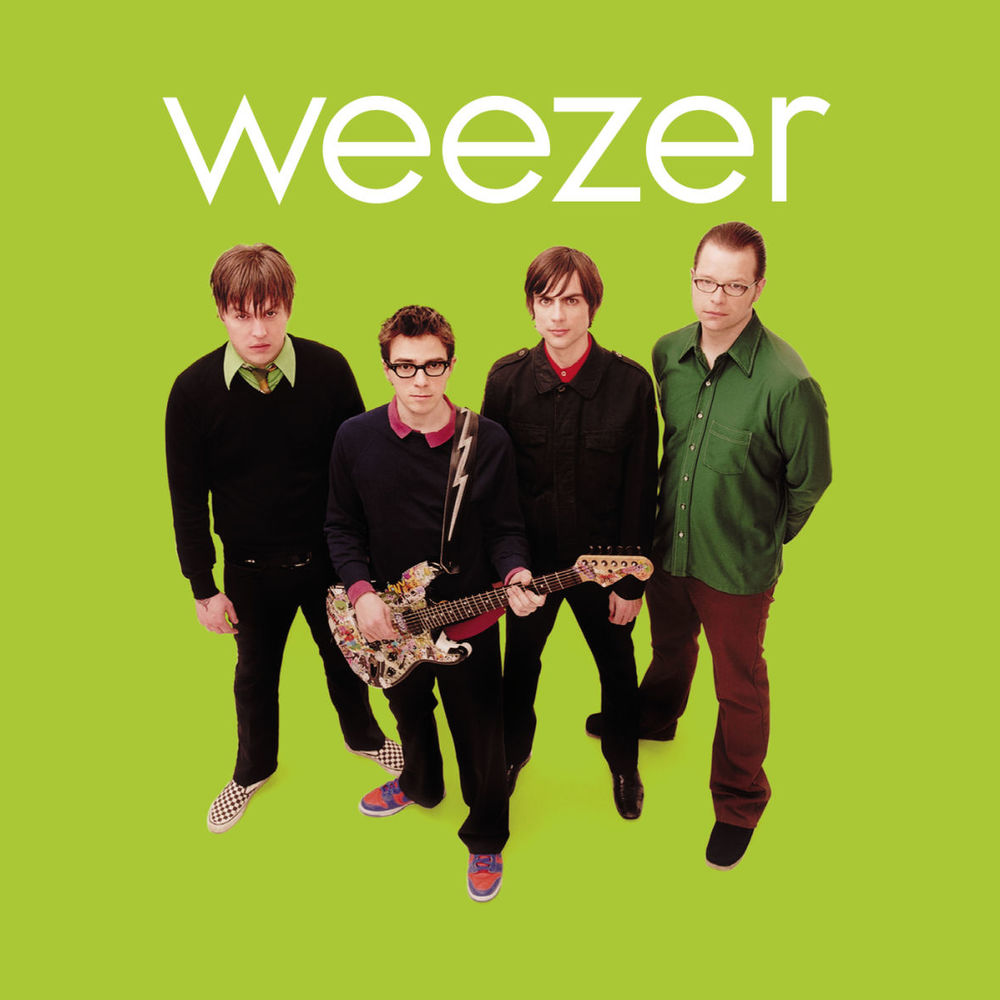
Weezer (Green Album)
- Released24 April 2001
- UK peak No. 21
- Weeks on UK chart 26
- Entered UK chart 26 February 1995
- LabelGeffen
- Tracks10 · 29 min
2 tracks from it charted as singles. Press a flag to play it in the chart where it peaked.
Tracks
| 1 | Don't Let Go | 2:59 | |
| 2 | Photograph | 2:19 | |
| 3 | Hash Pipe No. 21 · 2001 | 3:06 | |
| 4 | Island In The Sun No. 31 · 2001 | 3:20 | |
| 5 | Crab | 2:34 | |
| 6 | Knockdown Dragout | 2:08 | |
| 7 | Smile | 2:40 | |
| 8 | Simple Pages | 2:57 | |
| 9 | Glorious Day | 2:41 | |
| 10 | O Girlfriend | 3:50 |
About the album
Weezer (commonly known as the Blue Album) is the debut studio album by the American rock band Weezer, released on May 10, 1994, by DGC Records. It was produced by Ric Ocasek.
Weezer was formed in Los Angeles in 1992, and initially struggled to engage audiences, who were more interested in grunge. Their demo The Kitchen Tape brought them to the attention of DGC owner Geffen Records. Weezer selected Ocasek because of his work with the Cars.
Most of the album was recorded at Electric Lady Studios in New York City between August and September 1993. The group treated the guitars and bass as a single, 10-string instrument, playing in unison. The guitarist Jason Cropper was fired during recording, as the band felt he was threatening their chemistry; he was replaced by Brian Bell.
Weezer was supported by the singles "Undone – The Sweater Song", "Buddy Holly", and "Say It Ain't So", which were accompanied by music videos. The album received acclaim and reached number sixteen on the Billboard 200, and was certified five-times platinum in the US in 2024. It remains Weezer's best-selling album, with more than 15 million copies sold worldwide by 2009. It has been named one of the best albums of the 1990s by several publications. In 2020, Rolling Stone ranked it number 294 on its list of the "500 Greatest Albums of All Time".
Background
Weezer was formed on February 14, 1992, in Los Angeles by singer and guitarist Rivers Cuomo, drummer Pat Wilson, bassist Matt Sharp, and guitarist Jason Cropper. Although they performed future hits including "Undone – The Sweater Song" and "Say It Ain't So", Cuomo said they struggled to engage audiences, who wanted to see grunge bands instead.
In an effort to create buzz around Los Angeles, Weezer recorded a demo, The Kitchen Tape. This attracted attention from major-label A&R reps looking for alternative rock bands to perform on the same bill as That Dog. Weezer were signed to DGC Records on June 26, 1993, by Todd Sullivan, an A&R rep from Geffen Records.
Recording and production
While preparing for the studio sessions, Weezer focused on their vocal interplay by practicing barbershop quartet-style songs, which helped Cuomo and Sharp feel more comfortable collaborating during rehearsals. Sharp, who had never sung before joining Weezer, developed his falsetto: "I had to sing an octave higher than Rivers. After a lot of practice, I started to get it down."
Weezer rehearsed 15 songs in New York City in preparation for the Electric Lady Studios sessions. Four songs from this rehearsal were not included on the album: "I Swear It's True", "Getting Up and Leaving", a reprise of "In the Garage", and "Mykel and Carli", an ode to the sisters Mykel and Carli Allan, who ran the Weezer fanclub. Weezer later recorded another version of "Mykel and Carli" as a B-side for the single "Undone – The Sweater Song", with the Weezer collaborator Karl Koch.
Weezer considered self-producing the album, but were pressured by Geffen to choose a producer. They decided on Ric Ocasek, who was the frontman for the Cars.
Music and lyrics
Musically, Weezer has been described as power pop, geek rock, pop-punk, alternative rock, indie rock, emo, and post-grunge. The album has been described as a fusion of "chart-angled hook-craft" with "roaring" guitar distortion, confessional lyrics and "unashamedly vibrant" melodies. Andy Price of Guitar.com stated that the album's sound and aesthetic were "distinctly non-alternative", stating that the band instead "took their style cues from the DIY slackers of the lo-fi indie scene, albeit with a broader audience in mind." Stephen Thomas Erlewine of AllMusic described the album's sound as "sunny, heavy guitar pop." According to Tim Sendra, also of AllMusic, the album "skillfully fuses the raucous energy of punk, the loser-friendly geekiness of indie rock, the guitar power of grunge, and the huge hooks of radio rock -- then adds some heavy metal guitar heroics and Rivers Cuomo's oddball lyrical perspective." David Silverberg of Grammy Awards wrote that the album is "brimming with [...] chunky riffs [and] sublime solos."
The first single, "Undone – The Sweater Song", was described by
Artwork
The album artwork was photographed by Peter Gowland. In it, Wilson, Cuomo, Sharp, and Bell are depicted standing in front of a plain blue background, "simply standing and staring at the camera." According to David Silverburg of the Grammy Awards, the album's front cover "evoked a feeling of awkward geekiness that would eventually lead to the album's designation as being the harbinger of nerd rock and its many acolytes." Cuomo stated that although the band approved of the photo, Sharp expressed dissatisfaction with the way his head was appearing, so a Geffen art director used Adobe Photoshop to replace his head with one from another shot.
The image was used prominently in advertising for the album. The cover was compared to that of the Feelies' album Crazy Rhythms, which Weezer had no prior knowledge of. Instead, according to the Weezer collaborator Karl Koch, Cuomo was inspired by the cover of a cheap Beach Boys greatest-hits cassette, which featured the Beach Boys with striped shirts in front of a blue background.
Release and promotion
The Blue Album was released on May 10, 1994. "Undone – The Sweater Song" was released as the lead single on June 24, 1994. The video was directed by Spike Jonze, whose pitch was simply "a blue stage, a steadicam, a pack of wild dogs". The video became an instant hit on MTV. The final single, "Say It Ain't So", was released on July 13, 1995. The music video, directed by Sophie Muller, was less successful, and featured the band performing in the garage of their former house and playing hacky sack in the yard.
Weezer was certified gold on December 1, 1994, and was certified platinum on January 13, 1995. It was certified double platinum on August 8, 1995 and triple platinum on November 13, 1998. It reached no. 16 on the Billboard 200. "Undone – The Sweater Song" reached no. 35 on the UK Top 40, and "Buddy Holly" and "Say It Ain't So" reached no. 12 and no. 37 on the UK Top 40. In the U.S., "Buddy Holly" reached no.