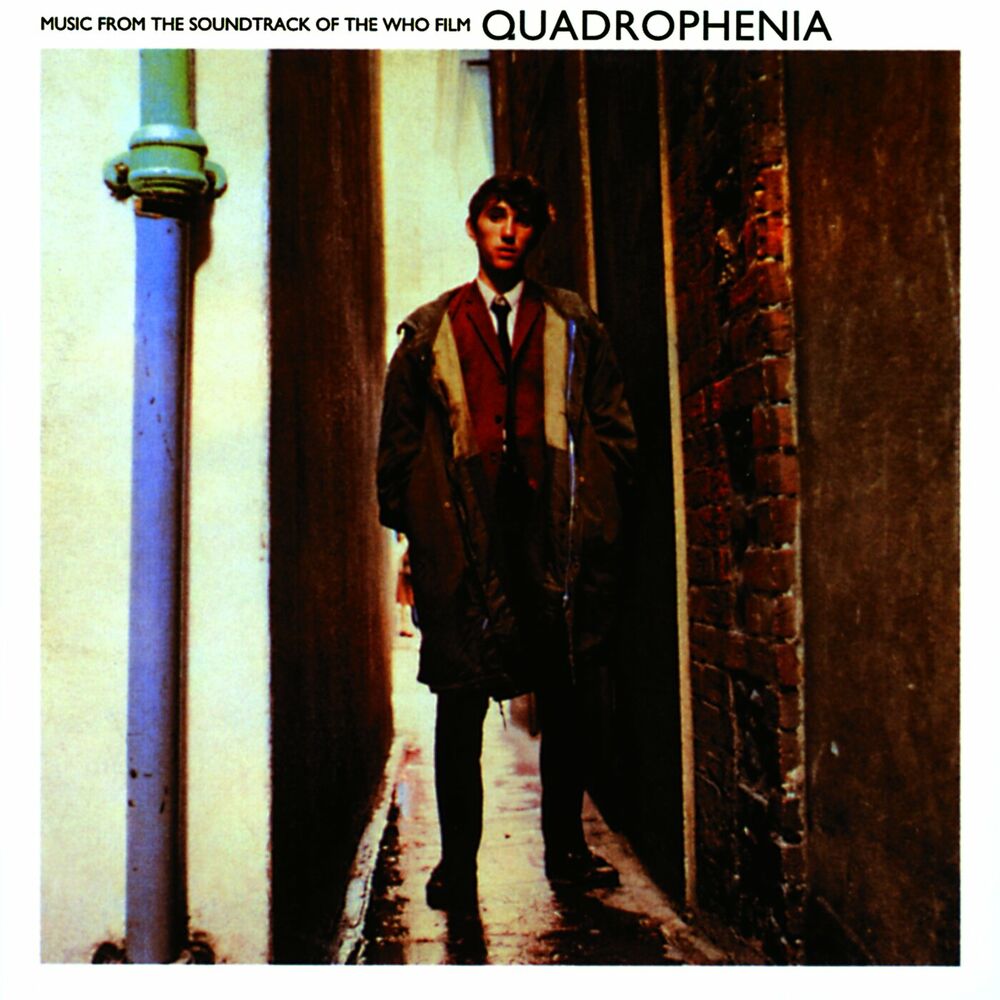
Quadrophenia (Original Motion Picture Soundtrack)
- Released25 May 2015
- UK peak No. 2
- Weeks on UK chart 13
- Entered UK chart 11 November 1973
- LabelPolydor Records
- Tracks23 · 77 min
3 tracks from it charted as singles. Press a flag to play it in the chart where it peaked.
Tracks
| 1 | I Am The Sea | 2:03 | |
| 2 | The Real Me No. 92 · 1974 | 3:28 | |
| 3 | I'm One | 2:40 | |
| 4 | 4:50 | ||
| 5 | Love Reign O'er Me No. 76 · 1973 | 5:11 | |
| 6 | Bell Boy | 4:55 | |
| 7 | I've Had Enough | 6:11 | |
| 8 | Helpless Dancer | 0:21 | |
| 9 | Doctor Jimmy | 7:29 | |
| 10 | Zoot Suit (The High Numbers) | 2:00 | |
| 11 | Hi Heel Sneakers (Cross Section) | 2:46 | |
| 12 | Get Out And Stay Out | 2:27 | |
| 13 | Four Faces | 3:19 | |
| 14 | Joker James | 3:13 | |
| 15 | The Punk And The Godfather | 5:28 | |
| 16 | Night Train (James Brown) | 3:30 | |
| 17 | Louie Louie (The Kingsmen) | 2:49 | |
| 18 | Green Onions (Booker T. & the M.G.'s) | 2:46 | |
| 19 | Rhythm Of The Rain (The Cascades) | 2:31 | |
| 20 | He's So Fine (The Chiffons) | 1:52 | |
| 21 | Be My Baby (The Ronettes) | 2:30 | |
| 22 | Da Doo Ron Ron (The Crystals) | 2:18 | |
| 23 | I'm The Face (The High Numbers) | 2:36 |
About the album
Quadrophenia is the sixth studio album by the English rock band the Who, released as a double album on 26 October 1973 by Track Records. It is the group's third rock opera, the previous two being the "mini-opera" song "A Quick One, While He's Away" (1966) and the album Tommy (1969). Set in London and Brighton in 1965, the story follows a young mod named Jimmy and his search for self-worth and importance. Quadrophenia is the only Who album entirely written by Pete Townshend.
The group started work on the album in 1972 in an attempt to follow up Tommy and Who's Next (1971), both of which had achieved substantial critical and commercial success. Recording was delayed while bassist John Entwistle and singer Roger Daltrey recorded solo albums and drummer Keith Moon worked on films. Because their new studio was not finished in time, the group had to use Ronnie Lane's Mobile Studio. The album makes significant use of Townshend's multi-track synthesizers and sound effects, as well as Entwistle's layered horn parts.
Background
The year 1972 was the least active year for the Who since they had formed. The group had achieved great commercial and critical success with the albums Tommy and Who's Next, but were struggling to come up with a suitable follow-up. The group recorded new material with Who's Next collaborator Glyn Johns in May 1972, including "Is It in My Head" and "Love Reign O'er Me" which were eventually released on Quadrophenia, and a mini-opera called "Long Live Rock – Rock Is Dead", but the material was considered too derivative of Who's Next and sessions were abandoned. In an interview for Melody Maker, guitarist and bandleader Pete Townshend said, "I've got to get a new act together… People don't really want to sit and listen to all our past." He had become frustrated that the group had been unable to produce a film of Tommy (a film version of Tommy was eventually released in 1975) or Lifehouse (the abortive project that resulted in Who's Next), and decided to follow Frank Zappa's idea of producing a musical soundtrack that could produce a narrative in the same way as a film.
Recording
In order to do justice to the recording of Quadrophenia, the group decided to build their own studio, Ramport Studios in Battersea. Work started on building Ramport in November 1972, but five months later it still lacked an adequate mixing desk that could handle recording Quadrophenia. Instead, Townshend's friend Ronnie Lane, bassist for Faces, loaned his mobile studio for the sessions. Lambert ostensibly began producing the album in May, but missed recording sessions and generally lacked discipline. By mid-1973, Daltrey demanded that Lambert leave the Who's services. The band recruited engineer Ron Nevison, who had worked with Townshend's associate John Alcock, to assist with engineering.
To illustrate the four-way split personality of Jimmy, Townshend wrote four themes, reflecting the four members of the Who. These were "Bell Boy" (Moon), "Is It Me?" (Entwistle), "Helpless Dancer" (Daltrey) and "Love Reign O'er Me" (Townshend). Two lengthy instrumentals on the album, the title track and "The Rock", contain the four themes, separately and together.
Release
The album was preceded by the single "5:15" in the UK, which benefited from a live appearance on Top of the Pops on 4 October 1973 and was released the next day. It reached No. 20 in the charts. In the US, "Love Reign O'er Me" was chosen as the lead single.
Quadrophenia was originally released in North America on 26 October and in the UK on 29 October, but fans found it difficult to find a copy due to a shortage of vinyl caused by the OPEC oil embargo. In the UK, Quadrophenia reached No. 2, being held off the top spot by David Bowie's Pin Ups. The album reached No. 2 on the US Billboard chart, the highest position of any Who album in that country, being kept from No. 1 by Elton John's Goodbye Yellow Brick Road.
The album was originally released as a two-LP set with a gatefold jacket and a booklet containing lyrics, a text version of the story, and photographs taken by Ethan Russell illustrating it. MCA Records re-released the album as a two-CD set in 1985 with the lyrics and text storyline on a thin fold-up sheet but none of the photographs.
Critical reception
Critical reaction to Quadrophenia was positive. Melody Maker's Chris Welch wrote "rarely have a group succeeded in distilling their essence and embracing a motif as convincingly", while Charles Shaar Murray described the album in New Musical Express as the "most rewarding musical experience of the year". Reaction in the US was generally positive, though Dave Marsh, writing in Creem gave a more critical response. Lenny Kaye wrote in Rolling Stone that "the Who as a whole have never sounded better" but added, "on its own terms, Quadrophenia falls short of the mark". In a year-end top albums list for Newsday, Robert Christgau ranked it seventh, and found it exemplary of how 1973's best records "fail to reward casual attention. They demand concentration, just like museum and textbook art."
Retrospective reviews were also positive.