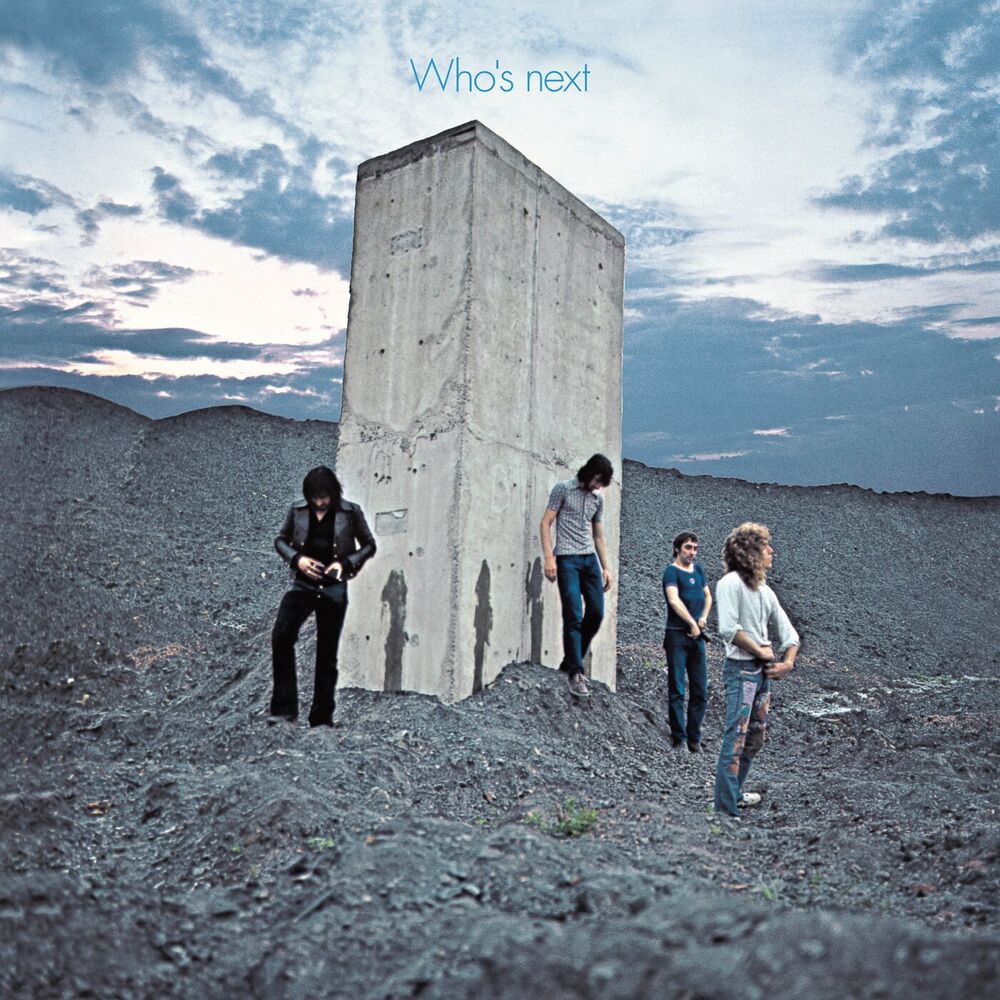
Who's Next (Remastered 2022)
- Released29 August 1995
- UK peak No. 1
- Weeks on UK chart 18
- Entered UK chart 5 September 1971
- LabelUMC (Universal Music Catalogue)
- Tracks9 · 44 min
3 tracks from it charted as singles. Press a flag to play it in the chart where it peaked.
Tracks
| 1 | Baba O'Riley (Remastered 2022) No. 55 · 2012 | 5:08 | |
| 2 | Bargain (Remastered 2022) | 5:34 | |
| 3 | Love Ain't For Keeping (Remastered 2022) | 2:10 | |
| 4 | My Wife (Remastered 2022) | 3:41 | |
| 5 | The Song Is Over (Remastered 2022) | 6:24 | |
| 6 | Getting In Tune (Remastered 2022) | 4:50 | |
| 7 | Going Mobile (Remastered 2022) | 3:45 | |
| 8 | Behind Blue Eyes (Remastered 2022) No. 34 · 1971 | 3:42 | |
| 9 | 8:32 |
About the album
Who's Next is the fifth studio album by the English rock band the Who, released on 2 August 1971, by Track Records in the United Kingdom and by Decca Records in the United States. It developed from the aborted Lifehouse project, a multi-media rock opera conceived by the group's guitarist Pete Townshend as a follow-up to the band's 1969 album Tommy. The project was cancelled owing to its complexity and to conflicts with Kit Lambert, the band's manager, but the group salvaged some of the songs, without the connecting story elements, to release as their next album. Eight of the nine songs on Who's Next were from Lifehouse, with the lone exception being the John Entwistle–penned "My Wife". Ultimately, the remaining Lifehouse tracks would all be released on other albums or as standalone singles throughout the next decade.
The Who recorded Who's Next with assistance from recording engineer Glyn Johns. After producing the song "Won't Get Fooled Again" in the Rolling Stones Mobile Studio, they relocated to Olympic Studios to record and mix most of the album's remaining songs. They made prominent use of synthesisers on the album, particularly on "Won't Get Fooled Again" and "Baba O'Riley", which were both released as singles.
Background
By 1970, the Who had obtained significant critical and commercial success, but they had started to become detached from their original audience. The mod movement had vanished, and the original followers from Shepherd's Bush had grown up and acquired jobs and families. The group had started to drift apart from manager Kit Lambert, owing to his preoccupation with his label, Track Records. They had been touring since the release of Tommy the previous May, with a set that contained most of that album, but realised that millions had now seen their live performances, and Pete Townshend in particular recognised that they needed to do something new. A single, "The Seeker", and a live album, Live at Leeds, were released in 1970, and an EP of new material ("Water", "Naked Eye", "I Don't Even Know Myself", "Postcard", and "Now I'm a Farmer") was recorded, but not released, as the band felt it would not be a satisfactory follow-up to Tommy.
Instead, the group tackled a project called Lifehouse.
Recording and production
The first session for what became Who's Next was at Mick Jagger's house, Stargroves, at the start of April 1971, using the Rolling Stones Mobile. The backing track of "Won't Get Fooled Again" was recorded there before the band decided to relocate recording to Olympic at Johns' suggestion; the first session there was on 9 April, attempting a basic take of "Bargain". The bulk of the sessions occurred during May, when the group recorded "Time Is Passing", "Pure and Easy", "Love Ain't for Keeping" (which had been reworked from a rock track into an acoustic arrangement), "Behind Blue Eyes", "The Song Is Over", "Let's See Action" and "Baba O'Riley". Nicky Hopkins guested on piano, while Dave Arbus was invited by Moon to play violin on "Baba O'Riley".
Release and promotion
The lead single from the album, "Won't Get Fooled Again" (edited down to three and a half minutes), was released ahead of the album on 25 June 1971 in the UK and in July in the US; it reached No. 9 and No. 15 in the charts of the respective countries. The album was released on 2 August in the US and on 27 August in the UK. It became the only album by the Who to top the UK charts.
The Who started touring the US just before the album was released. They used the Lifehouse PA, though soundman Bob Pridden found the technical requirements of the equipment to be over-complicated. The set list was revamped, and, while it included a smaller selection of numbers from Tommy, several songs from the new album, such as "My Wife", "Baba O'Riley", and "Won't Get Fooled Again", became live favourites. The latter two songs involved the band playing to a backing track containing the synthesizer parts.
Critical reception and legacy
Reviewing for The Village Voice in 1971, music critic Robert Christgau called Who's Next "the best hard rock album in years" and said that, while their previous recordings were marred by a thin sound, the group now "achieves the same resonant immediacy in the studio that it does live". Billy Walker from Sounds highlighted the songs "Baba O'Riley", "My Wife", and "The Song Is Over", and wrote: "After the unique brilliance of Tommy something special had to be thought out and the fact that they settled for a straight-forward album rather than an extension of their rock opera, says much for their courage and inventiveness." Rolling Stone magazine's John Mendelsohn felt that, despite some amount of seriousness and artificiality, the album's brand of rock and roll is "intelligently-conceived, superbly-performed, brilliantly-produced, and sometimes even exciting". At the end of 1971, the record was voted the best album of the year in the Pazz & Jop, an annual poll of American critics published by The Village Voice.
Retrospectively, Who's Next has often been viewed as the Who's best album.