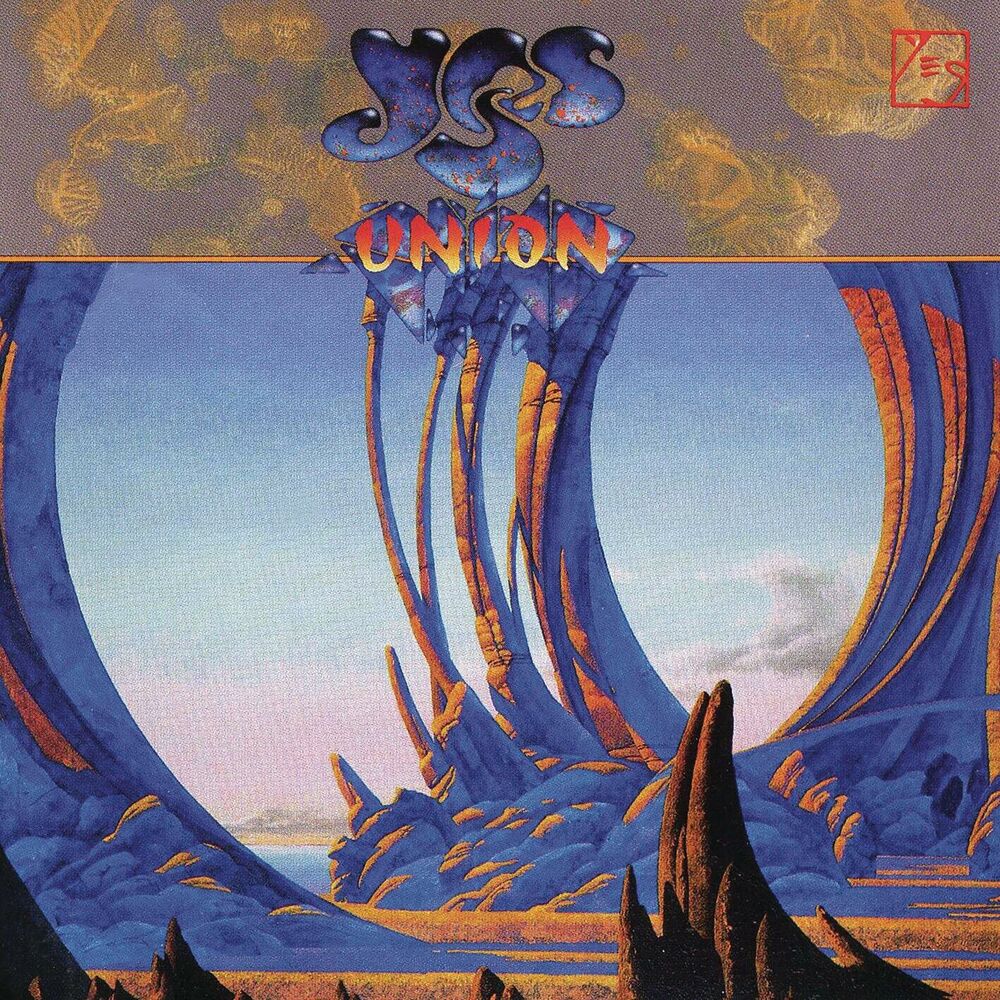
Union
- Released26 April 1991
- UK peak No. 7
- Weeks on UK chart 6
- Entered UK chart 5 May 1991
- LabelArista
- Tracks14 · 65 min
One track from it charted as a single. Press a flag to play it in the chart where it peaked.
Tracks
| 1 | I Would Have Waited Forever | 6:32 | |
| 2 | Shock To The System | 5:08 | |
| 3 | Masquerade | 2:16 | |
| 4 | Lift Me Up No. 86 · 1991 | 6:28 | |
| 5 | Without Hope You Cannot Start The Day | 5:17 | |
| 6 | Saving My Heart | 4:39 | |
| 7 | Miracle Of Life | 7:29 | |
| 8 | Silent Talking | 3:58 | |
| 9 | The More We Live - Let Go | 4:51 | |
| 10 | Angkor Wat | 5:22 | |
| 11 | Dangerous (Look In the Light of What You're Searching For) | 3:35 | |
| 12 | Holding On | 5:23 | |
| 13 | Evensong | 0:51 | |
| 14 | Take The Water To The Mountain (Edit) | 3:16 |
About the album
Union is the thirteenth studio album by the English progressive rock band Yes, released on 30 April 1991 by Arista Records. The album was conceived following the amalgamation of two separate groups featuring current and former members of Yes: Anderson Bruford Wakeman Howe (ABWH)—comprising Jon Anderson, Bill Bruford, Rick Wakeman, and Steve Howe—and the remaining members of the band's 1980s lineup, consisting of Chris Squire, Trevor Rabin, Tony Kaye, and Alan White. After ABWH's recorded tracks were rejected by their label as uncommercial, and the alternative Yes line-up continued auditioning replacement lead vocalists following the commercial success of 90125 (1983) and Big Generator (1987), management and record executives brokered a commercial merger to combine their separate, unfinished material into a single unified project.
The album's production was highly problematic and characterised by internal friction. Due to creative differences and scheduling conflicts during the ABWH sessions, co-producer Jonathan Elias and Anderson chose to heavily overdub and replace Wakeman and Howe's parts with contributions from session musicians, a move that drew severe criticism from the affected band members. Concurrently, the Squire and Rabin-led faction contributed four tracks, which were largely developed from solo demos and collaborative material with Billy Sherwood.
Background
The origins of Union stem from a deep schism within Yes during the late 1980s, which divided the musicians into two distinct factions. Following a period of major commercial success with the albums 90125 (1983) and Big Generator (1987), frontman Jon Anderson grew dissatisfied with the band's pop-oriented musical direction and departed in 1988. Anderson subsequently reunited with 1970s-era alumni Bill Bruford, Rick Wakeman and Steve Howe to form the spin-off group Anderson Bruford Wakeman Howe (ABWH), alongside bassist Tony Levin. While ABWH successfully toured their self-titled 1989 debut for Arista Records, the remaining four members of Yes—guitarist Trevor Rabin, bassist Chris Squire, drummer Alan White and keyboardist Tony Kaye—retained the official band moniker under Atco Records.
Artwork and packaging
The band commissioned long-time collaborator Roger Dean to design the album's cover art and packaging. Prior to the project's consolidation, Dean had been developing a modernised text layout and a new square-shaped geometric emblem for the artwork of the second, unreleased Anderson Bruford Wakeman Howe studio album, which was operating under the working title Dialogue. When the project was abruptly shifted into a full Yes release, Dean elected to reinstate his classic, rounded "bubble" logo—originally designed in 1972—for the album's front cover to visually signal the return of the historic lineup, while utilising the newer square design variant in the packaging's margins.
Release and commercial performance
Union was released on 30 April 1991 through Arista Records, issued concurrently across compact disc, vinyl LP, and cassette formats. The album experienced immediate commercial success, peaking at number seven on the UK Albums Chart during a six-week chart residency. In the United States, the album debuted on the Billboard 200 at number 35 before it rose to its peak position of number 15 the following week and ultimately remained on the chart for a total of 19 weeks. On 2 July 1991, the Recording Industry Association of America (RIAA) officially awarded the release a gold certification, signifying a shipment threshold of 500,000 units in the United States.
The album's critical profile was boosted in early 1992 when Howe's solo acoustic guitar track, "Masquerade", earned a Grammy Award nomination for Best Rock Instrumental Performance. Reflecting on the recognition in light of the severe internal tracking overrides, Howe characterised the nomination as "pure justice" for his isolated creative efforts.
Singles
Arista released three singles throughout 1991. The lead single, "Lift Me Up", was issued in April 1991 alongside a cinematic promotional music video directed by Steven Goldmann. The song became one of the most successful rock radio tracks of the band's career, achieving a consecutive six-week run at number one on the Billboard Album Rock Tracks chart from 4 May through 8 June 1991. The single also crossed over to mainstream Top 40 formats, peaking at number 86 on the Billboard Hot 100.
The second single, "Saving My Heart", was released in July 1991. Driven by its accessible, reggae-tinged layout, the track reached number nine on the Album Rock Tracks chart by mid-August. "I Would Have Waited Forever" was the third and final single, serviced primarily to rock radio stations as a promotional CD single asset.
Critical reception
Union received mixed to negative reviews from music critics upon release, who frequently criticised its disjointed nature and corporate-driven overproduction. The majority of the band members have since openly disowned the project; Bruford described it as the worst album of his career, while Wakeman famously nicknamed it Onion because it made him cry upon listening.
Writing for Rolling Stone, Chuck Eddy awarded the release two out of five stars, dismissing it as "an eclectic miscarriage that almost isn't even worth laughing about" while criticising the lack of cohesive guitar hooks, memorable riffs, and direct lyrical focus. British newspaper The Guardian published a negative review from Adam Sweeting, who considered the eight-member formation "severely over-manned" and the album "progressive pomp."
Robert Sandall of British magazine Q observed that the album "veers alarmingly between ... neurotically jumpy overarrangements and competing time signatures" from the ABWH camp and aggressive "heads-down riffing" from the 1980s Yes lineup.